
Key Takeaways
- An attestation letter is a short, signed document from the testing firm confirming that a penetration test was completed, what it covered, when it happened, and the overall outcome. It is meant to be shared, unlike the full report.
- Enterprise buyers and auditors often ask for proof of testing without needing every finding. A letter lets you answer that request without handing a detailed vulnerability list to people outside your company.
- A letter is only as credible as the engagement behind it. It should state the scope, the testing window, the methodology, and whether findings were retested.
- Request the letter after retesting, not before, so it reflects your current remediated state instead of a point in time with open issues.
A security questionnaire arrives from an enterprise prospect with one line that stalls a deal: “Please provide your most recent penetration test report.” Sending the full document is rarely a good idea, since it is a detailed map of where your application was weak. A pentest attestation letter exists for exactly this moment. It gives the reviewer the proof they need, and keeps the sensitive detail where it belongs.
What a Pentest Attestation Letter Actually Is
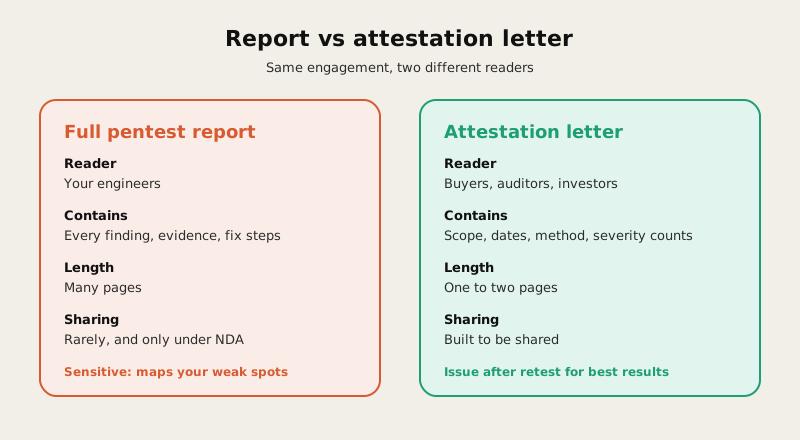
A pentest attestation letter is a one or two page document, issued and signed by the firm that performed the test, that summarizes the engagement at a high level. It is not a certification and it is not a guarantee that an application is secure. It is a statement that a qualified third party tested a defined scope during a defined window using a recognized methodology, and what the overall result was.
The full report and the letter serve different readers. The report is written for your engineers, with technical detail, evidence, and fix guidance. The letter is written for people outside engineering: a procurement analyst, a customer security team, an auditor, or an investor running diligence.
What a Good Letter Should Include
Reviewers tend to look for the same handful of items. A letter missing several of them usually draws follow up questions, which defeats its purpose.
- The testing firm and the client, named clearly, with the firm’s contact details.
- The scope. The specific applications, APIs, or environments tested, and any explicit exclusions.
- The testing window. Start and end dates, so the reviewer can judge how current the test is.
- The methodology. A named standard such as OWASP or NIST SP 800-115, the federal technical guide to security testing.
- A findings summary by severity. Counts of critical, high, medium, and low findings, without describing the vulnerabilities themselves.
- Remediation and retest status. Whether findings were fixed and whether the firm verified the fixes.
- Tester credentials and a signature, so the letter can be traced to a named, accountable person.
Have a deal waiting on proof of testing and unsure what to send? Book a scoping call and we will walk through what your buyer actually needs to see.
When to Send the Letter Instead of the Report
Should you ever send the full pentest report to a customer? Sometimes, but usually under an NDA and only when the buyer has a specific reason to need the detail. For most first round reviews, a letter is enough, and the full report can be offered later on request.
In practice, the letter covers the first stage of most enterprise reviews, where the question is simply whether you test your application and how recently. The full report becomes relevant later, for example when a customer’s security team wants to read the severity ratings themselves. We cover how reviewers judge the report itself in our guide on whether enterprises accept a pentest report from a boutique firm.
Mistakes That Weaken a Pentest Attestation Letter
A letter can look reassuring and still fall short, and each of these tends to draw questions. These are the problems reviewers most often notice:
- Issued before the retest. A letter that lists open critical findings reads very differently from one confirming they were fixed. Waiting for the retest usually produces a stronger, more accurate document.
- Vague scope. “Application security assessment” tells a reviewer nothing. The letter should name what was actually tested.
- No dates. Without a testing window, the reviewer cannot tell whether the test is recent enough to rely on.
- A letter with no report behind it. Reviewers sometimes ask to see the underlying report under NDA. If one does not exist or cannot be shared, the letter loses credibility.
- Reusing an old letter. A letter describes one engagement. After significant changes to your product, an older letter may no longer represent what is in production.
How We Handle Attestation Letters
Upon request, we issue a signed attestation letter with each completed engagement and scoped to what was actually tested and dated to the testing window, and we issue it after retesting so it reflects your remediated state. Founders who already know the letter is going to a specific buyer or auditor can tell us up front, and we will confirm the format that reviewer expects. The cost of an engagement depends on scope, which we break down in our SaaS penetration testing page.
FAQ
Is a pentest attestation letter the same as a pentest certificate? Not exactly. Neither is a formal certification of security. A letter is a signed statement about a specific engagement, and it should be read as proof that testing happened, not proof that nothing is vulnerable.
Will an auditor accept a letter instead of the full report? It depends on the auditor and the framework. Some accept a letter for initial evidence and ask for the report only if they have questions, while others want the report itself, so confirm with your auditor early.
Can a letter hide bad results? A credible letter does not. It states the severity counts and the remediation status honestly. A letter that omits findings entirely would draw questions from any careful reviewer.
How long is an attestation letter valid? There is no fixed expiry, but most reviewers treat a test older than twelve months with caution, and a major product change can make an older letter less relevant.
If a customer or auditor is asking for proof of testing and you need a clean, credible letter, book a scoping call, or start with our SaaS penetration testing page for more info.
Packet33 is a penetration testing and compliance advisory firm serving SaaS and HealthTech startups in the US, Canada, and UK.

Mohamed is the founder of Packet33. He worked as a cybersecurity analyst before launching the firm and now leads an OSCP-certified team serving SaaS and HealthTech startups in the US, Canada, and UK.