
Key Takeaways
- Can you fail a pentest is the wrong question, a penetration test produces a findings report, not a pass or fail grade, and this holds true for SaaS and HealthTech startups alike.
- Critical findings are common, not rare, most first pentests for a growing startup surface at least one high or critical severity issue, and that is normal, not a sign something went wrong with your product.
- What actually matters is what happens after the report, how quickly findings get remediated and whether a retest confirms the fix, not the raw number of findings in the initial report.
- A high finding count on a first pentest is often a sign the engagement was thorough, not a sign the vendor did a bad job or the product is unusually insecure.
Can you fail a pentest is one of the most common anxieties founders bring into their first engagement, and the honest answer is that the framing itself is off. A penetration test is not an exam with a passing score, it is a structured attempt to find real, exploitable weaknesses in your application, and finding them is the entire point of paying for one. For a SaaS or HealthTech startup preparing for a first pentest, understanding what actually happens when critical findings show up matters more than worrying about a grade that does not exist.
Why There Is No Pass or Fail
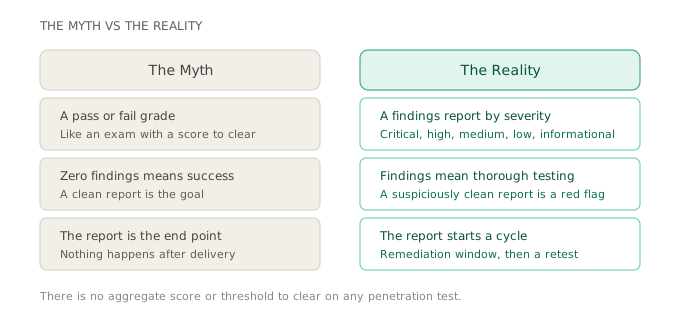
A pentest report lists findings by severity, critical, high, medium, low, and informational, along with remediation guidance for each. There is no aggregate score, no percentage, and no threshold you clear or miss. This is different from an audit, where SOC 2 or HIPAA compliance can technically pass or fail based on whether controls meet defined criteria. A pentest is closer to a health screening than a test, it tells you what is actually present, and what you do with that information afterward is the part that matters.
This distinction matters especially for a startup’s first pentest. Founders sometimes delay testing out of fear that a bad report will scare off an investor or an enterprise prospect. In practice, the opposite is usually true, a report with findings and a clear remediation plan signals a company that takes security seriously enough to look for problems before an attacker does. A suspiciously clean first report, on the other hand, is often a sign the testing was not thorough enough to find anything real.
What Actually Happens When Critical Findings Show Up
SaaS startup pentest findings that come back critical or high severity are common, not exceptional, particularly on a first engagement. A typical pattern for a growing company is a handful of medium severity issues plus one or two findings that need immediate attention, often something like a missing authorization check on a newer API endpoint or a role based access control gap that only shows up when a tester deliberately tries to break it. For HealthTech companies specifically, HealthTech pentest critical findings often cluster around PHI handling, an endpoint that was scoped correctly for one user role but not tested against every role combination that could reach it.
What happens next is a remediation window, typically 30 to 90 days depending on severity, followed by a retest to confirm the fix actually closed the gap. This cycle, finding, remediation, retest, is the actual product of a pentest engagement, not the initial report by itself. A vendor who treats the initial report as the finish line, rather than the starting point for this cycle, is not delivering the full value of the engagement.
Worried about what a first pentest might surface for your specific application? Book a scoping call and we will walk through what to expect and how remediation timelines typically work.
What Happens After a Pentest, Practically Speaking
What happens after a pentest depends more on how you handle the findings than on what the findings actually were. A report with several critical findings that get remediated and retested within a reasonable window is a stronger position, for an auditor, an investor, or an enterprise prospect, than a report with zero findings and no evidence the testing was rigorous. Our pentest report next steps post covers this remediation and retest cycle in more depth, including how to use a report constructively in sales and compliance conversations rather than treating it as something to hide.
For a SaaS penetration test specifically, the goal is not walking away with a clean report, it is walking away with an accurate picture of your actual risk and a plan to close it, which is a very different thing than passing or failing.
Frequently Asked Questions
Is it bad if my startup’s pentest finds critical vulnerabilities? No. Critical findings on a first pentest are common and are not a reflection of poor engineering, they reflect thorough testing. What matters is how quickly they get remediated, not whether they were found in the first place.
Can a pentest disqualify us from a deal or an audit? The pentest itself does not, an unaddressed critical finding with no remediation plan can. Auditors and enterprise security teams generally want to see evidence of remediation, not a report with zero findings.
Should we be worried if our first pentest report is longer than expected? Not inherently. A longer report often reflects more thorough manual testing, not a worse product. A very short report from a first engagement is sometimes a sign the testing was too shallow to find what a real attacker would.
Can you fail a pentest is a question worth retiring from your vocabulary entirely, what you actually get is a findings report and a remediation plan, and both are working exactly as intended.
If your SaaS or HealthTech startup is preparing for its first pentest and you want to know what to actually expect, book a scoping call and we will walk through the process.
Packet33 is a penetration testing and compliance advisory firm serving SaaS and HealthTech startups in the US, Canada, and UK.

Mohamed is the founder of Packet33. He worked as a cybersecurity analyst before launching the firm and now leads an OSCP-certified team serving SaaS and HealthTech startups in the US, Canada, and UK.