
Key Takeaways
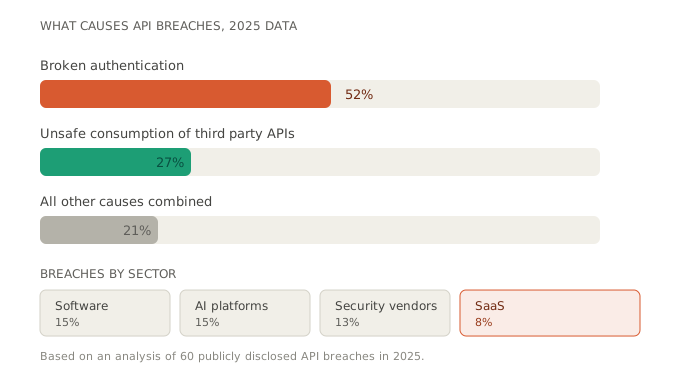
- An analysis of 60 disclosed API breaches in 2025 found broken authentication caused 52 percent of incidents, with unsafe consumption of third party APIs accounting for another 27 percent.
- SaaS companies accounted for 8 percent of breaches in that same sector breakdown, alongside software (15 percent), AI platforms (15 percent), and cloud services (7 percent).
- Average daily API attacks per organization rose 113 percent year over year, from 121 to 258 attacks, according to Akamai’s 2026 State of the Internet report.
- 67 percent of API vulnerabilities are rated high or critical impact, yet 56 percent are exploitable by low skill actors, meaning severity and attacker sophistication are not closely linked.
- Behavior based attacks, meaning abuse of legitimate but unauthorized workflows rather than classic exploits, accounted for 61 percent of API attacks in 2025, up sharply from 30 percent the year before.
SaaS API security incidents in 2026 point to a consistent pattern across published breach data, most incidents are not caused by exotic zero day exploits, they are caused by authentication and authorization gaps that a manual review is specifically built to catch. For a growing SaaS startup, understanding what the actual breach data shows matters more than generic advice to “secure your APIs.”
What Actually Causes API Breaches
An analysis of 60 publicly disclosed API breaches in 2025 found broken authentication responsible for 52 percent of incidents, more than any other single cause. These API breach statistics 2026 analysts have converged on show unsafe consumption of third party APIs, meaning a breach originating from a connected vendor or integration rather than a company’s own code, accounting for another 27 percent. Sector breakdowns from the same analysis show software companies at 15 percent of breaches, AI platforms also at 15 percent, cybersecurity vendors at 13 percent, and SaaS companies specifically at 8 percent, alongside cloud services and automotive each around 7 percent.
This data lines up closely with what shows up in manual testing engagements generally. Authentication and authorization flaws are not rare edge cases, they are the dominant cause of real world API breaches, which is exactly the category of finding that manual penetration testing is specifically designed to catch, since these flaws usually require a tester attempting to actually abuse a role or session, not just scanning for a known signature.
Attack Volume Is Rising Fast
Beyond causes, the volume of API attacks itself has grown sharply. Akamai’s 2026 State of the Internet report found average daily API attacks per organization rose 113 percent year over year, from 121 to 258 attacks. More notably, the type of attack is shifting, behavior based attacks, meaning abuse of legitimate but unauthorized workflows rather than a traditional exploit, accounted for 61 percent of API attacks in 2025, up from just 30 percent the year before. This shift matters because behavior based abuse is precisely what automated scanning tools are weakest at detecting, since there is no broken code to flag, only a workflow being used in a way it was never intended to be used.
Curious whether your own API surface has an authentication or authorization gap that would show up in this kind of data next year? Book a scoping call and we will talk through what manual testing would actually cover.
Why Severity and Sophistication Do Not Line Up
One of the more counterintuitive findings in the 2026 data is that 67 percent of API vulnerabilities are rated high or critical impact, yet 56 percent are exploitable by low skill actors, with another 40 percent tied to organized cybercrime rather than sophisticated nation state activity. This matters for how a growing SaaS startup should think about risk. A high severity API vulnerability does not require a nation state adversary to become a real problem, it just requires someone willing to try, which is a much larger population of potential attackers than most founders assume.
What This Means for a Growing SaaS Startup
The practical implication of this data for API security startup planning is straightforward. Authentication and authorization testing should be the priority in any SaaS penetration test, not an afterthought behind broader infrastructure testing. SaaS API vulnerabilities tied to unsafe third party consumption account for over a quarter of breaches, meaning a company’s own code being clean is not sufficient, the integrations and vendors a product depends on need to be part of the risk picture too.
Frequently Asked Questions
What is the leading cause of SaaS API security incidents? Broken authentication, responsible for 52 percent of the 60 API breaches analyzed in a 2025 dataset, more than any other single cause. Unsafe consumption of third party APIs was the second leading cause at 27 percent.
Are API breaches usually caused by sophisticated attackers? Not typically. While 67 percent of API vulnerabilities are rated high or critical severity, 56 percent are exploitable by low skill actors, meaning severity does not require a sophisticated adversary to become a real risk.
Why do automated scans miss so many API vulnerabilities? Behavior based attacks, abuse of a legitimate workflow rather than a coding flaw, accounted for 61 percent of API attacks in 2025. This kind of abuse has no signature to detect, it requires a human tester attempting to misuse the application the way a real attacker would.
If you want to know whether your SaaS product’s API surface has the kind of authentication or authorization gap that shows up in this data, book a scoping call and we will walk through what manual testing would find.
Packet33 is a penetration testing and compliance advisory firm serving SaaS and HealthTech startups in the US, Canada, and UK.

Mohamed is the founder of Packet33. He worked as a cybersecurity analyst before launching the firm and now leads an OSCP-certified team serving SaaS and HealthTech startups in the US, Canada, and UK.