
Getting a pentest report is the easy part. Knowing your pentest report next steps, how to read the findings, what to fix before sharing it, and how to present it to an enterprise prospect or auditor without creating more problems than you solve, is where most SaaS founders get stuck. This is everything that comes after the report arrives.
Understanding What You Actually Received
A pentest report is not a pass or fail document. It is a snapshot of your security posture at a specific point in time, produced by testers who spent a defined window actively attempting to find and exploit weaknesses in your environment. How you read and act on it matters as much as having it.
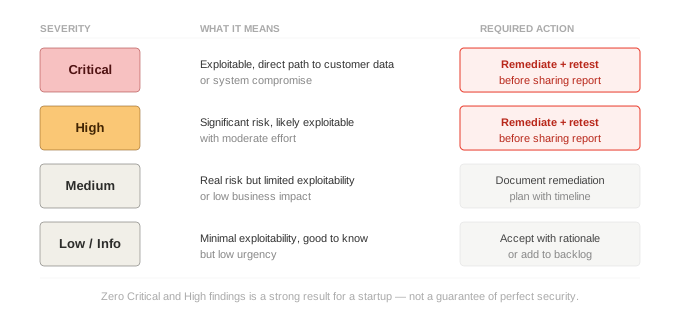
Most pentest reports are organized around findings, each assigned a severity rating, typically Critical, High, Medium, Low, and Informational. The severity reflects both how exploitable the vulnerability is and what the potential business impact would be if it were exploited.
The first thing to understand is that findings in a pentest report do not all carry equal weight. A Critical finding that allows an unauthenticated attacker to access customer data requires immediate action before you share the report with anyone. A Low finding about a misconfigured HTTP header that has no meaningful path to exploitation carries minimal urgency. When founders receive their first pentest report and see a list of 30 findings across severity levels, the reaction is often disproportionate to the actual risk. Context matters.
The second thing to understand is that a clean report with zero Critical and High findings is a strong result for a startup. Not a guarantee of perfect security as no pentest covers every possible attack vector, but rather evidence that your core controls are working and that your most significant exposures have been addressed. Auditors and enterprise security teams know this.
Pentest Report Next Steps Before You Share It With Anyone
Before you send a pentest report to a prospect, investor, or auditor, there are several things you need to do.
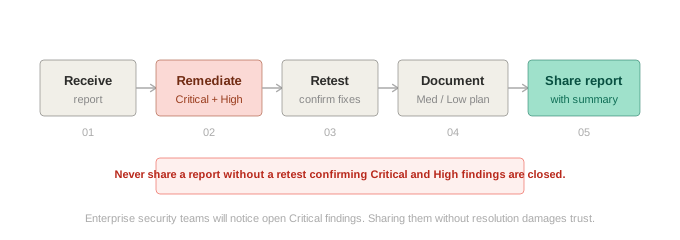
Remediate your Critical and High findings. This is non-negotiable. Sharing a report that contains open Critical or High vulnerabilities tells the recipient that you are aware of a significant security gap and chose not to address it before sending them a document describing how to exploit it. Enterprise security teams will notice. Auditors will flag it. Remediate these findings, retest to confirm they are closed, and get a retest letter or updated report from your testing firm before sharing anything externally.
Document your remediation plan for everything else. Medium and Low findings do not all need to be fixed before you share the report, but you need to be able to articulate what your plan is for each one. Accepted risk needs to be documented with a rationale. Planned remediation needs a timeline. “We are aware of this and have decided it is acceptable given the limited exploitability” is a defensible position. “We have not looked at it yet” is not.
Understand the scope limitations. Every pentest covers a defined scope, specific applications, IP ranges, environments. Make sure you can clearly articulate what was tested and what was not. If a prospect asks whether your mobile application was included and it was not in scope, you need to know that before you are asked.
Know your methodology. Enterprise security questionnaires will ask about the testing methodology, was it black box, gray box, or white box? Gray box is the most common in our experience. What frameworks were used, OWASP, PTES, NIST? Was it manual testing, automated scanning, or a combination? Testers with credentials like OSCP or CREST are often specifically asked about. Make sure you can answer these questions confidently before you share the report.
How to Use It in a Sales Conversation
A well-presented pentest report is a sales asset, not just a compliance artifact. The way you present it signals as much as its contents.
The right approach is to proactively address the findings rather than hoping the prospect does not ask about them. When you share the report, include a brief summary that covers the scope and methodology, the most significant findings and their current remediation status, and what the results demonstrate about your overall security posture. This puts you in control of the narrative rather than leaving a security team to form their own interpretation.
If your report contains open findings, explain your remediation plan with specific timelines. Enterprise security teams evaluate vendor risk continuously. A startup that found a vulnerability, documented a plan to address it, and communicated that plan proactively signals operational maturity. A startup that tries to bury findings or claims a report is clean when it is not will lose trust the moment the discrepancy is noticed.
The other thing worth knowing is that your pentest report often shortcircuits the most time-consuming part of an enterprise security review. When a prospect’s security team can read a current, well-scoped report from a credentialed firm, it frequently replaces weeks of back-and-forth questionnaires and custom assessments. Deals that were stalled in security review often move forward faster once a quality report is in hand.
Talk to us about scoping a pentest for your environment.
How to Use It for Compliance
If you are pursuing SOC 2, ISO 27001, or HIPAA compliance, your pentest report becomes evidence in your compliance program.
For SOC 2, the report supports the monitoring activities criteria, specifically CC4.1, which requires ongoing evaluations to validate that your security controls are present and functioning. Your auditor may not require a pentest, but most enterprise customers will ask for one when reviewing your SOC 2 report, and having it available removes a common friction point in vendor security reviews.
For HIPAA, annual penetration testing is proposed under the 2025 Security Rule NPRM, not yet finalized as of mid-2026, but already the defensible standard most auditors expect and what enterprise healthcare buyers require. Your report needs to cover systems that process or store electronic protected health information, be conducted by qualified professionals, and be dated within the past 12 months.
For ISO 27001, your pentest supports several Annex A controls related to technical vulnerability management and security testing in development. Auditors increasingly expect to see pentest evidence as part of a mature ISMS.
In all cases, the report needs to be current. A test from 18 months ago that predates significant infrastructure changes provides limited assurance and will draw questions from auditors and enterprise buyers. Annual testing, timed to align with your compliance audit window, is the standard that serious enterprise customers expect.
The Retest Is Not Optional
After your team has addressed the findings in your report, you need a retest. A retest is a focused follow-up engagement where your pentest firm verifies that the vulnerabilities they identified have been properly remediated and that no new issues were introduced in the process of fixing them.
Without a retest, you have an open list of findings with no documented verification that they were closed. Sharing a report in that state puts you in a weaker position than sharing nothing, because you have disclosed vulnerabilities without evidence of resolution.
Most pentest engagements include a retest as part of the scope. If yours did not, it is worth going back to your testing firm to request one before you share the report externally or submit it as compliance evidence.
The Bigger Picture
A pentest is a point-in-time assessment. Your security posture changes continuously as you ship code, change infrastructure, add vendors, and grow your team. The report you received represents how things looked during a specific testing window. That is valuable. It is not a permanent certification.
The companies that use pentesting most effectively treat it as part of an ongoing security program rather than a one-time exercise. Annual testing aligned with their compliance audit cycle. Scope updated when their product or infrastructure changes meaningfully. Findings tracked and remediated through a documented process.
For SaaS startups, getting the first pentest done is a significant step. Knowing what to do with the results, how to read them, how to present them, how to remediate them, and how to incorporate them into your compliance evidence is what separates a pentest that closes deals from one that sits in a folder.
Packet33 conducts web application, API, and external network penetration testing for SaaS and HealthTech startups, with reports scoped and documented for SOC 2, HIPAA, and ISO 27001 requirements. We also help clients understand their findings and build remediation plans that satisfy both auditors and enterprise security teams.
If you want a quote tied to your actual environment instead of a flat rate guess, book a scoping call and we will walk through what drives your specific number, start with our SaaS penetration testing post if you want the full breakdown of what is included first.
Packet33 is a penetration testing and compliance advisory firm serving SaaS and HealthTech startups in the US, Canada, and UK.

Mohamed is the founder of Packet33. He worked as a cybersecurity analyst before launching the firm and now leads an OSCP-certified team serving SaaS and HealthTech startups in the US, Canada, and UK.