
Key Takeaways
- LLM penetration testing covers the AI features inside your product, such as chat assistants, summarizers, and agents. A standard web app test usually does not exercise them in any depth.
- The highest risk areas are usually data leaking between customers, the model being steered by untrusted input, and AI features that can call tools or APIs with more access than they need.
- The OWASP Top 10 for LLM Applications is the most common reference for scoping this work, and enterprise buyers increasingly recognize it.
- You do not need a separate program. LLM testing is best added to a normal SaaS pentest as scoped AI coverage, because the AI feature still sits on top of your usual authentication, APIs, and data layer.
If your product now includes an AI assistant, a summarization feature, or an agent that takes actions for users, the way you think about LLM penetration testing matters before your next enterprise review. A standard pentest checks the application around the feature. It often does not test what the feature itself can be tricked into doing.
How LLM Features Change Your Attack Surface
A traditional SaaS application takes structured input and returns predictable output. An LLM feature takes free text, combines it with context you supplied, and decides what to do next. That creates a different kind of weakness: instead of only asking “can an attacker bypass this check,” testers also ask “can an attacker persuade this feature to ignore its own rules.”
Three things make this worth testing separately:
- The input is untrusted and unbounded. Users, uploaded documents, web pages, and emails can all end up in the model’s context.
- The feature often holds privileged context. System instructions, other users’ data pulled in for retrieval, and connected tools all sit within reach of the model.
- The feature can act. An assistant that can send messages, query records, or call internal APIs turns a text problem into a data or permissions problem.
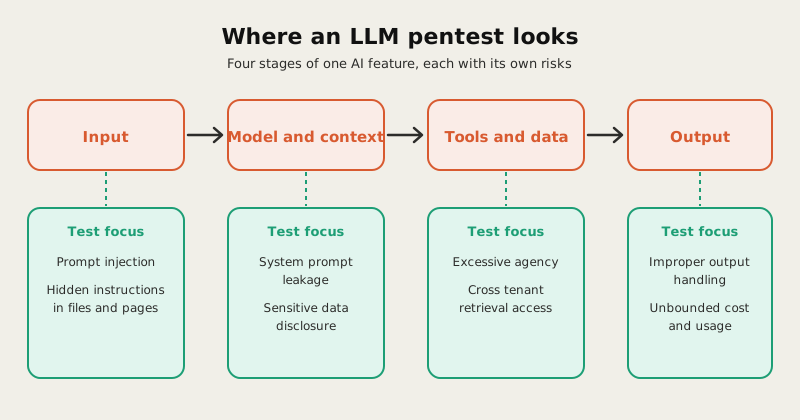
What LLM Penetration Testing Should Cover
The OWASP Top 10 for LLM Applications gives a useful structure. In practice, a test for a SaaS product usually concentrates on these areas:
- Prompt injection. Whether instructions hidden in user input, documents, or retrieved content can override how the feature is supposed to behave.
- Sensitive information disclosure. Whether one customer can get the model to reveal another customer’s data, or reveal data it should not surface at all.
- Cross tenant isolation in retrieval. If your feature searches a knowledge base or document store, whether the access controls that protect that data in the main app also apply to what the model can retrieve.
- Excessive agency. Whether the feature can call tools or APIs with broader permissions than the user who is talking to it.
- Improper output handling. Whether model output is passed into the browser, a database query, or another system without being treated as untrusted.
- System prompt leakage. Whether instructions or secrets placed in the prompt can be extracted.
- Unbounded consumption. Whether a user can drive up cost or degrade service through crafted or repeated requests.
Not sure which AI features in your product need to be in scope? Book a scoping call and we will map them to a test plan before quoting anything.
What Stays the Same From a Standard Pentest
An AI feature is still software, and it still depends on the same foundations. Authentication, authorization, the APIs behind the feature, and how data is stored all matter just as much as before. In many real cases the most serious finding is not a clever prompt, it is an ordinary access control gap that the AI feature happens to make easier to exploit. That is why LLM coverage fits best inside a broader SaaS penetration testing engagement instead of replacing it.
What Enterprise Buyers Are Starting to Ask
Security questionnaires are beginning to include questions about AI features, such as how customer data is used by the model, whether it is isolated between tenants, and whether the AI features have been tested. A report that names the AI scope explicitly gives you a direct answer, while a general application report may leave the question open. If you are weighing how much of this automation can replace human testing, we cover that debate in our post on whether AI can replace penetration testing.
How to Scope LLM Testing Before You Book
Bring a short inventory so a vendor can quote accurately:
- Which features use an LLM, and which model or provider sits behind each one.
- What data the feature can read, including documents, records, and other users’ content.
- What tools or APIs the feature can call, and with whose permissions.
- Whether users can upload files or paste content that ends up in the model’s context.
- Whether the feature acts on its own or waits for the user to approve each step.
How We Approach AI Features
We treat the AI feature as one more path into your data, so we test it alongside the application it lives in. We start from what the feature can reach and do, then work outward to the places where untrusted input meets that access. Findings are written so your engineers can fix them and so a buyer’s security team can read the scope without needing to ask what was covered.
FAQ
Is LLM penetration testing different from a normal pentest? It overlaps heavily, since the same authentication, APIs, and data stores are involved, but it adds testing of how the model behaves with untrusted input and what it can access or do on a user’s behalf.
Do we need it if we only use a third party model API? Often yes. The model provider secures the model, but you are responsible for what data you send it, what tools it can call, and how its output is handled inside your product.
Can a scanner test an LLM feature? Automated tools can help with coverage, but judging whether a response leaks data across customers or whether a tool call exceeded a user’s permissions usually needs manual testing and an understanding of your product.
How often should AI features be tested? At least annually with your regular pentest, and after meaningful changes such as a new model, a new tool the feature can call, or new data sources added to retrieval.
If your product has AI features and a buyer or auditor is starting to ask about them, book a scoping call, or start with our SaaS penetration testing page for more info.
Packet33 is a penetration testing and compliance advisory firm serving SaaS and HealthTech startups in the US, Canada, and UK.

Mohamed is the founder of Packet33. He worked as a cybersecurity analyst before launching the firm and now leads an OSCP-certified team serving SaaS and HealthTech startups in the US, Canada, and UK.