
Key Takeaways
- A December 2025 Stanford, Carnegie Mellon, and Gray Swan study pitted 10 OSCP certified human testers against 7 AI agent frameworks on a live 8,000 host network, not a lab exercise.
- The best performing AI framework placed second overall, ahead of 9 of the 10 human testers, but still carried a higher false positive rate than every human tested.
- An autonomous AI agent reached number one on HackerOne’s bug bounty leaderboard, submitting roughly 1,060 reports in 90 days, of which only about 130 were confirmed as valid.
- CVE Bench data shows AI success rates nearly double when an agent is handed a known vulnerability description versus asked to find one from scratch, AI is measurably better at exploiting known issues than discovering novel ones.
- Real world business logic exploitation in custom applications remains the specific, measurable gap the 2026 benchmark data has not closed.
Can AI replace penetration testing is no longer a hypothetical question in 2026, it is a question with actual benchmark data behind it, and the honest answer is more specific than either side of the debate usually presents. Autonomous AI agents are now genuinely competitive at large scale vulnerability discovery. They have not closed the gap on the specific work that makes a penetration test valuable in the first place.
The Study That Actually Tested This
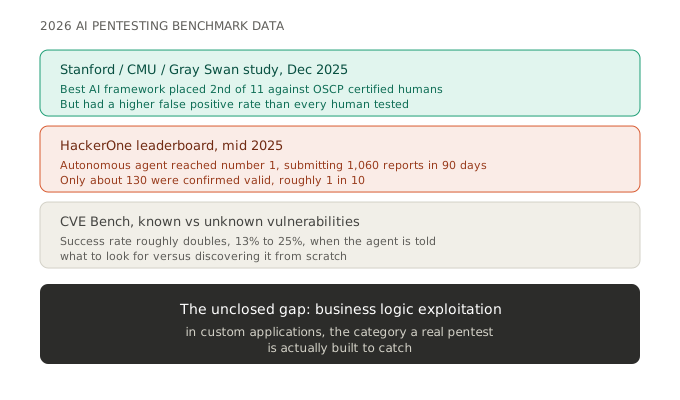
In December 2025, researchers from Stanford, Carnegie Mellon, and Gray Swan AI ran the most rigorous head to head comparison published to date. Ten OSCP certified human penetration testers competed against seven AI agent frameworks on a live 8,000 host network across 12 subnets, a real enterprise environment rather than a controlled capture the flag exercise. The best performing AI framework placed second overall, outperforming 9 of the 10 human testers on raw results.
That result alone sounds like it settles the can AI replace penetration testing question outright. It does not, because of what the same study found underneath the headline number. The AI framework carried a higher false positive rate than every single human tester in the study, and it specifically struggled with business logic testing and GUI based interactions, the categories of finding that require understanding what an application is supposed to do, not just what vulnerabilities are present in its code.
What the Numbers Actually Mean When You Look Closer
A few other 2026 data points round out the picture, and each one reveals a gap that headline results tend to obscure.
An autonomous AI agent reached number one on HackerOne’s bug bounty leaderboard in mid 2025, submitting approximately 1,060 vulnerability reports across live programs over roughly 90 days. Of those, only about 130 were confirmed as valid and awarded, meaning roughly one in ten submissions actually held up. Volume and accuracy are not the same thing, and a report full of false positives creates real triage work for whoever has to sort through it.
CVE Bench, a benchmark specifically designed to test AI agents against real world CVEs, found something even more telling. Success rates nearly double when an agent is handed the description of a known vulnerability versus being asked to discover one from scratch, moving from roughly 13 percent to 25 percent in the same benchmark. That gap is the clearest evidence available that current AI systems are meaningfully better at exploiting known, described issues than at discovering novel ones, which is precisely the opposite of what a genuinely creative attacker does.
Curious whether your application’s specific business logic would hold up against a real manual tester rather than an automated scan? Book a scoping call and we will talk through what manual testing would actually cover.
Where This Leaves the Real Decision
None of this means AI has no place in security testing, it clearly accelerates the parts of the work that are genuinely repetitive, known vulnerability pattern matching, initial reconnaissance, and first draft report generation. What the 2026 benchmark data actually shows is a specific, measurable boundary rather than a vague argument about creativity. AI vs human penetration testers is not really a replacement question, it is a question of which categories of finding each approach is suited for, and manual penetration testing continues to own the category that matters most for a SaaS application, authorization logic, role based access control, and the kind of multi tenant boundary flaw that only shows up when a tester deliberately tries to break the business logic rather than scan for known signatures.
For a growing SaaS or HealthTech company deciding how to allocate a security budget, the practical takeaway from an autonomous AI pentest benchmark is not “skip the human tester,” it is “know which category of risk you are actually trying to close.” Known vulnerability coverage is increasingly commoditized. The business logic and authorization flaws that tend to matter most for a SaaS penetration test are exactly the category the current data says AI has not caught up on yet.
Frequently Asked Questions
Has AI actually beaten human penetration testers in a real test? Yes, in the December 2025 Stanford, Carnegie Mellon, and Gray Swan study, the best AI framework placed second overall against 10 OSCP certified humans on a live network. It still had a higher false positive rate than every human tested and struggled with business logic testing specifically.
Is autonomous AI pentesting reliable enough to replace a manual pentest? Not for the categories that matter most in a typical SaaS application. Current data shows AI performs well on known, pattern matched vulnerabilities but has a measurable, unclosed gap on novel business logic exploitation and false positive accuracy.
Will this gap close as AI models improve? Possibly, and the trend over the past two years shows real progress. As of the most recent 2026 benchmark data, the gap remains specific and measurable rather than closed, particularly around real world web application business logic testing, which multiple studies describe as the current unsolved frontier.
Based on the actual 2026 data, can AI replace penetration testing is answered honestly as not yet, and not for the findings that matter most.
If you want to know exactly what a manual pentest would find in your specific application, book a scoping call and we will walk through what that actually looks like.
Packet33 is a penetration testing and compliance advisory firm serving SaaS and HealthTech startups in the US, Canada, and UK.

Mohamed is the founder of Packet33. He worked as a cybersecurity analyst before launching the firm and now leads an OSCP-certified team serving SaaS and HealthTech startups in the US, Canada, and UK.