
Key Takeaways
- Penetration testing after a breach has a different goal than a routine annual test, it needs to confirm the specific vulnerability is closed and check for related issues nearby, not survey the whole application from scratch.
- Move fast, but not before containment and root cause work are done. Testing an environment mid incident wastes the engagement.
- Customers, investors, and partners will ask what changed after a breach. A post incident pentest report is often the single artifact that answers that question credibly.
- A vendor who already understands the specific vulnerability class involved will scope and deliver faster than one starting from zero.
A breach changes the question a pentest is answering. Before an incident, the question is usually broad: what could go wrong. After one, it narrows sharply: is the thing that actually went wrong now fixed, and what else looks like it. Founders who treat post incident testing like a routine annual pentest often end up with a report that technically happened but does not answer the question anyone actually has.
Why Post Incident Scope Is Different
A standard SaaS penetration test surveys an application broadly, looking across authentication, authorization, input handling, and infrastructure for whatever is there to find. Penetration testing after a breach starts from a known point of failure and works outward from it. If the incident involved a broken authorization check on one API endpoint, the test needs to confirm that specific class of issue is closed everywhere it could recur, not just on the endpoint that was exploited. Startups that skip this and simply schedule their next annual test as usual often miss adjacent instances of the exact pattern that caused the breach in the first place.
This is also where a vendor’s actual experience matters more than usual. A tester who has seen the specific vulnerability class before, whether that is broken object level authorization, exposed credentials, or a misconfigured cloud storage bucket, moves faster and knows where else to look. We cover the broader pattern of how access control failures show up across SaaS applications in our broken access control post, which is a useful reference if authorization was the root cause in your incident
When to Test After a Breach
Should you pentest immediately after a security incident, or wait? Wait until containment and root cause analysis are complete, then test as soon as the fix is deployed. Testing too early means validating a partial fix, and testing too late leaves a gap between remediation and verified proof it worked.
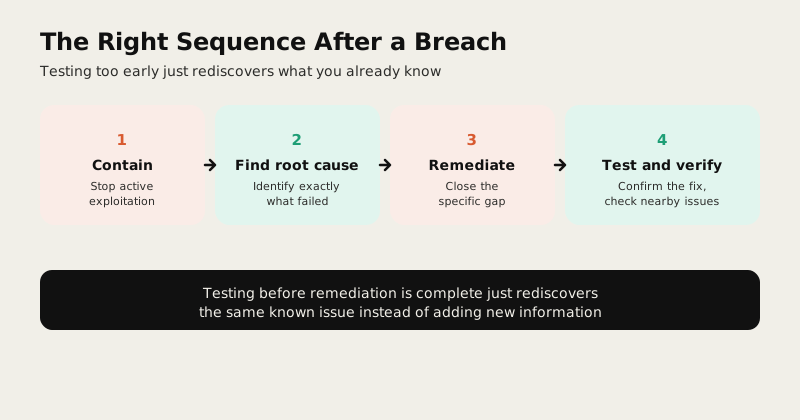
The sequence matters. Containment stops active exploitation. Root cause analysis identifies exactly what failed and why. Remediation closes that specific gap. Only then does a penetration test add value, since its job is to independently verify the fix holds and to look for related weaknesses the incident response process may not have covered. Running a pentest before remediation is complete wastes the engagement, since testers will simply rediscover the same known issue instead of surfacing what else needs attention.
Check our Penetration Testing services for SaaS Startups. Or Book a scoping call and we will walk through where you are in the process before recommending a timeline.
What a Post Incident Report Needs to Cover
A post incident pentest report earns its value by doing more than confirming the original vulnerability is closed. It should also cover:
- Direct verification of the fix. A clear statement that the specific vulnerability involved in the incident has been retested and confirmed remediated, not just assumed fixed because code was deployed.
- Related vulnerability classes. The same category of issue tested across the rest of the application, not only the original point of failure.
- A clean narrative for stakeholders. Customers, investors, and enterprise partners reviewing what happened want to see evidence of a fix, not just an internal assurance that it was handled. NIST SP 800-61, the federal incident handling guide, treats post incident verification as a distinct phase from remediation itself, and an independent pentest is one of the clearest ways to demonstrate that phase actually happened.
- Documentation your compliance framework expects. If you are pursuing or maintaining SOC 2 or HIPAA compliance, auditors increasingly expect evidence tied to specific incidents, not just a generic annual testing cadence.
Rebuilding Trust After a Breach
The technical fix is only part of what a breach requires. A credible, independently verified pentest report is often the artifact that lets a founder have a straight conversation with an affected customer or a nervous investor instead of an open ended one. Being able to say plainly what happened, what was fixed, and who verified it changes that conversation considerably, and it is a large part of why startups that treat post incident testing seriously tend to retain customer trust better than ones that quietly patch and move on.
How We Approach Post Incident Engagements
We scope post incident work around the actual root cause first, confirming exactly what failed before building out the rest of the test plan, rather than defaulting to a generic full application scope. That focus is what lets us turn around a post incident engagement faster than a routine annual test, since the highest priority area is already known before testing begins.
FAQ
How soon after a breach should you get a penetration test? As soon as containment and root cause remediation are complete, typically within a few weeks, so the verification stays close to the fix and stakeholders see evidence quickly.
Does a post incident pentest replace our annual pentest? No. A post incident test is narrowly scoped around the specific vulnerability and related patterns, while an annual test covers the full application. Most startups need both on their calendar.
Do we need to disclose a post incident pentest to customers? That depends on your contractual and regulatory obligations, but having the report ready is what lets you answer confidently if a customer or auditor asks what was done after the incident.
What if we do not know the exact root cause yet? A pentest is not the right first step. Root cause analysis needs to happen first, since testing an undiagnosed environment usually just rediscovers the same known problem instead of adding new information.
If you are working through remediation after an incident and need testing that moves at the pace your stakeholders expect, book a scoping call, or start with our SaaS penetration testing post for the full breakdown of what is included.
Packet33 is a penetration testing and compliance advisory firm serving SaaS and HealthTech startups in the US, Canada, and UK.

Mohamed is the founder of Packet33. He worked as a cybersecurity analyst before launching the firm and now leads an OSCP-certified team serving SaaS and HealthTech startups in the US, Canada, and UK.