
Key Takeaways
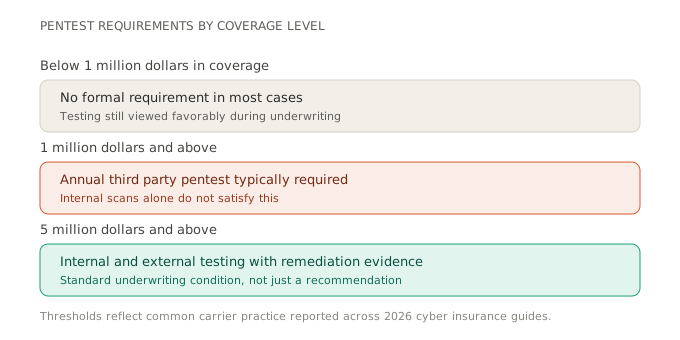
- Most carriers now require an annual third party penetration test for cyber insurance policies above 1 million dollars in coverage, and internal vulnerability scans do not satisfy this requirement on their own.
- Policies at 5 million dollars and above typically require documented internal and external testing with remediation evidence before coverage is issued or renewed.
- Regular penetration testing is associated with premium reductions of roughly 5 to 10 percent, with stacked security certifications pushing premiums 30 to 40 percent below market average in some reporting.
- Roughly 41 percent of cyber insurance applications are denied on first submission, missing controls and inadequate endpoint protection are the most cited reasons.
- Even when a pentest is not strictly required to bind a policy, a mismatch between what was attested on the application and what a forensic investigation finds after a breach is a common basis for claim denial.
Cyber insurance pentest requirements have tightened noticeably heading into 2026, and the coverage threshold at which testing shifts from optional to expected has dropped. For a growing SaaS or HealthTech company shopping for a policy, or renewing one, understanding where your coverage level lands on that threshold changes what your application actually needs to include.
When a Pentest Becomes Mandatory
Coverage size is the clearest line. 2026 cyber insurance requirements reporting converges on the same threshold across multiple carriers, policies above 1 million dollars in coverage typically require an annual, third party penetration test, and this cannot be satisfied by an internal vulnerability scan alone. Cyber insurance penetration testing and a routine vulnerability scan are treated as different things entirely by underwriters, a scan checks for known signatures, a penetration test involves a human tester attempting to actually exploit what is found. At 5 million dollars and above, the bar rises again, insurers typically expect documented internal and external testing, with evidence that findings were actually remediated, not just identified.
What Underwriters Actually Look For in the Report
A penetration test report submitted for underwriting purposes gets scrutinized for specific elements, not just its existence. Underwriters want to see the scope clearly defined, whether testing covered external systems, internal systems, or both. They want a named methodology, PTES, OWASP, or an equivalent framework, rather than a vague description of testing performed. The executive summary carries particular weight, since that is typically what an underwriter actually reads in full, with the detailed findings serving as supporting evidence. Our pentest report next steps post covers what a report needs to include in more depth, the same elements that make a report credible to an auditor tend to be exactly what an underwriter is checking for.
Why This Matters Even When Testing Is Not Strictly Required
This is the part of cyber insurance pentest requirements that gets missed most often. A pentest that is not explicitly required to bind your policy can still be the difference between a claim that pays out and one that does not. Cyber insurance applications ask you to attest to your security posture, and if a breach happens and a forensic investigation reveals that posture did not match what was attested, insurers have real grounds to deny the claim regardless of whether testing was formally mandatory at your coverage level. A recent, well scoped pentest is increasingly treated as due diligence evidence that your attestation was accurate, not just a box to check during underwriting.
Not sure whether your current coverage level requires a pentest, or whether your last report would actually hold up if a claim were ever contested? Book a scoping call and we will walk through what your policy actually expects.
Does Cyber Insurance Require a Pentest for Every Company?
Not universally, and coverage size is not the only variable. Industry, data sensitivity, and prior claims history all factor into what a specific carrier expects. A HealthTech company handling PHI is likely to face closer scrutiny than a general SaaS company at the same coverage level, simply because the potential claim severity is higher. The practical answer is that cyber insurance underwriting increasingly treats a properly scoped SaaS penetration test as a near universal expectation for any company carrying meaningful coverage, even in the cases where no explicit rule mandates it.
Frequently Asked Questions
Does cyber insurance require a pentest to get covered at all? Not universally, but most carriers require one for policies above 1 million dollars in coverage, and increasingly expect it as best practice even below that threshold. Internal scans alone typically do not satisfy the requirement.
Can penetration testing actually lower my premium? Reporting suggests regular testing is associated with premium reductions in the 5 to 10 percent range, with stacked security certifications and controls pushing discounts higher in some cases. Results vary by carrier and industry.
What happens if I get a pentest but my application still gets denied? Roughly 41 percent of cyber insurance applications are denied on first submission, most often due to missing controls like multi factor authentication or endpoint detection, not the absence of a pentest specifically. A pentest is one control among several underwriters expect to see documented together.
If your cyber insurance renewal is asking for a penetration test and you need one that will actually hold up to underwriter scrutiny, book a scoping call and we will walk through what your policy requires.
Packet33 is a penetration testing and compliance advisory firm serving SaaS and HealthTech startups in the US, Canada, and UK.

Mohamed is the founder of Packet33. He worked as a cybersecurity analyst before launching the firm and now leads an OSCP-certified team serving SaaS and HealthTech startups in the US, Canada, and UK.