
Every SaaS founder eventually asks the same question: if my GRC platform says I’m SOC 2 ready, why do I still need a consultant?
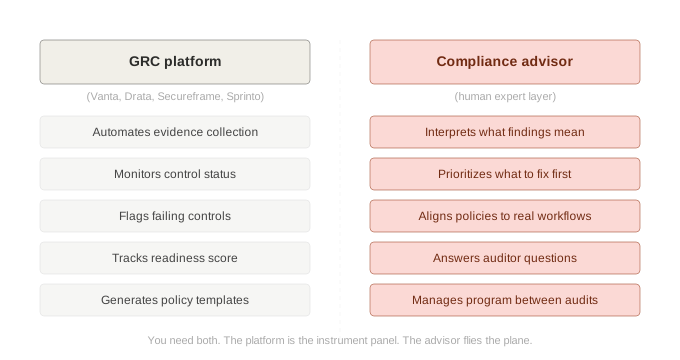
It’s a fair question. Vanta and Drata are genuinely good at what they do: automating evidence collection, tracking control status, and giving you a live view of where your program stands. None of that is in dispute.
What the dashboard can’t tell you is whether your policies still match what your team actually does, whether your evidence would survive an auditor’s follow-up question, or whether your program is built to hold up past the first audit. That’s a different kind of work, and it isn’t automatable.
This is not a knock on GRC platforms. The real question most SaaS founders are trying to answer isn’t whether to use one, it’s whether a compliance consultant belongs alongside it, and what each one is actually built to do.
What a GRC Platform Actually Does
GRC platforms are built to solve a specific and genuinely painful problem: the manual, time-consuming work of collecting evidence that your security controls exist. Before these platforms existed, compliance teams were taking screenshots, maintaining spreadsheets, and spending weeks reconstructing evidence packages before every audit. The automation these tools provide is real and valuable.
Here is what they do well. They connect to your AWS environment, your identity provider, your HR system, your code repository, and dozens of other tools. They run automated tests to check whether controls are configured correctly. They flag when something drifts out of compliance. They maintain a centralized evidence library. They give your auditor a structured place to review your program. They generate readiness scores that tell you how many controls are passing at any given moment.
That is a lot. For a lean startup team, that automation genuinely changes what is possible.
Here is what they cannot do.
A GRC platform is an instrument panel, not a pilot. It tells you what’s true right now. It doesn’t:
- Catch when a policy has drifted from what your team actually does day to day
- Anticipate the follow-up questions an auditor will ask about evidence that looks fine on paper
- Build the judgment call on what’s actually audit-ready versus what’s just checked off
That gap is where a consultant’s work starts. (For what happens to that gap after your first audit closes, see who’s actually running your compliance program between audits.)
All of those things require someone who understands both the framework and your specific business context. That is where a compliance advisor comes in.
What a Compliance Consultant Actually Does for SaaS Founders
A compliance advisor is not a replacement for your GRC platform. They work inside it. The distinction matters.
Where the platform surfaces data, the advisor interprets it. Where the platform flags a failing control, the advisor determines why it is failing, what needs to change, and whether it needs to be addressed before your next audit window or can be deprioritized. Where the platform generates a policy template, the advisor customizes it to match how your engineering team actually operates, so that when an auditor asks a question about your change management process, the answer your team gives matches what the policy says.
A compliance advisor also manages the things the platform cannot track at all. The quarterly access review that needs a human to review the list and make decisions about who loses access. The new vendor your product team added last month that needs to go through a security review and be documented in your vendor register. The risk register that needs to be updated because your company hired twenty people and launched a new product line since the last assessment. The tabletop exercise that needs to be planned, run, and documented.
Perhaps most importantly, a compliance advisor is the person who stands between your team and your auditor. When audit week arrives, having someone who knows your program, knows your auditor’s expectations, and can answer questions in real time without pulling your engineers off their work is not a minor convenience. It is the difference between an audit that wraps in five days and one that drags on for three weeks because of back-and-forth over evidence gaps.
The Question Most Founders Get Wrong
The question is not “do I need a GRC platform or a compliance advisor?” The question is “what does each one do, and do I have both covered?”
Most early-stage SaaS founders default to the assumption that their GRC platform subscription answers the compliance question. It does not. It answers the evidence collection and control monitoring question. That is a meaningful part of compliance. It is not the whole thing.
Think of it this way. Your GRC platform is the instrument panel in a plane. It gives you real-time data on altitude, airspeed, fuel, and whether any systems are out of range. That data is essential. But the instrument panel does not fly the plane. Someone who understands what the readings mean, knows how to respond when something goes wrong, and can make judgment calls under pressure has to be in the cockpit.
GRC platforms are increasingly good at their job. That is actually what creates more demand for compliance advisory, not less. As these tools become more capable, they surface more data, flag more issues, and generate more decisions that someone needs to make. The more your platform does, the more you need someone who can act on what it tells you.
When This Actually Matters
For a pre-seed or seed-stage company doing its first SOC 2 audit, the combination of a GRC platform and a compliance advisor is the standard approach taken by startups that get through their audit cleanly the first time. The platform handles the automation. The advisor handles everything the automation cannot.
For a company preparing for its second or third audit, the question is whether the compliance program has been actively managed between audits or just passively monitored. A high readiness score on your dashboard does not tell you whether your policies are current, your access reviews were completed and documented, or your vendor risk management process was followed every time a new tool was added. An advisor does.
For a company responding to an enterprise customer’s security questionnaire or preparing for investor due diligence, a compliance advisor is often the fastest path to producing accurate, defensible answers rather than scrambling to reconstruct the picture under pressure.
The GRC platforms themselves understand this. It is why platforms like Secureframe, Vanta, and Drata maintain partner directories of compliance advisory firms and actively refer customers who need the human layer on top of the software. The platforms are not trying to replace advisors. They are trying to make advisors more effective.
If you have a GRC platform subscription and are not sure whether your compliance program is being actively managed or just monitored, that is worth examining before your next audit window opens.
Talk to Packet33 about what the expert layer looks like for your compliance program.

Mohamed is the founder of Packet33. He worked as a cybersecurity analyst before launching the firm and now leads an OSCP-certified team serving SaaS and HealthTech startups in the US, Canada, and UK.