
Key Takeaways
- Building with AI coding tools is a legitimate way to ship fast, and a buyer or partner will still ask for the same independent testing evidence as for any other SaaS product.
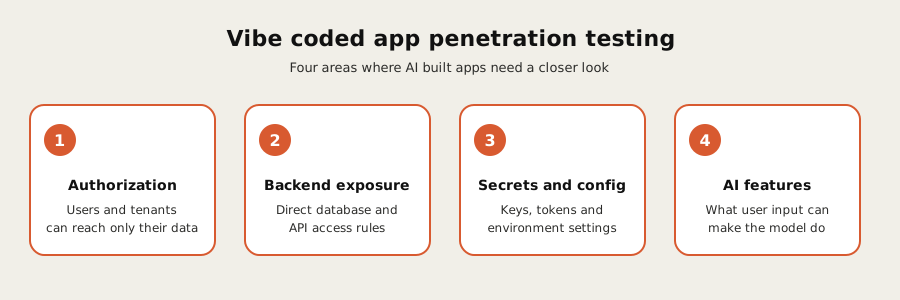
- Vibe coded app penetration testing should focus on what AI built apps most often get wrong: authorization between users and tenants, backend and API exposure, secrets and configuration, and AI features.
- The founder often does not know every endpoint the app exposes. A good test finds the real attack surface, not just the one the team describes.
- Ask vendors who do the manual testing, whether they test the backend directly, and how retesting works. A scanner report alone does not answer those questions.
If you built your product with AI coding tools, you are not unusual. Many early stage teams now ship working apps in weeks that used to take months. The question a customer, investor, or pilot partner will ask is the same either way: has someone independent tried to break it? Vibe coded app penetration testing is how you answer that with evidence. Here is how to scope it and what to ask before you hire anyone.
Why Vibe Coded Apps Deserve a Closer Look
AI coding tools are good at producing features that work. They are less reliable at producing features that stay safe when someone uses them in unexpected ways. A Veracode study published in July 2025 tested more than 100 language models on 80 coding tasks and found that the generated code introduced security vulnerabilities in 45 percent of cases. That is a lab result, not a prediction for your product, but it matches what many testers see: working code that skips a check nobody asked for.
The risk is less about the tool and more about review. When a founder prompts a feature into existence and tests that it works, the access rules, edge cases, and failure paths may never get a second look.
Where AI Built Apps Tend to Break
These areas come up most often, and they are where a manual test spends its time:
- Authorization between users and tenants. The app checks that you are logged in but not always whether you are allowed to see a specific record. One customer reaching another customer’s data is the classic result.
- Backend and API exposure. Many AI built apps connect the browser straight to a backend or database service. If the rules on that service are loose, the data is reachable without going through the app at all.
- Secrets and configuration. Keys, tokens, and test settings left in client code, repositories, or public environments.
- Missing server side checks. Validation that happens in the interface but not on the server, so anyone sending requests directly can bypass it.
- AI features. Prompts, tools, and integrations that let user input steer what the model does or what data it can see.
A founder may say the app has no API endpoints because none were written by hand. The browser is still talking to something, and that something is what a test needs to reach.
Built with AI tools and unsure what a test should cover? Book a scoping call and we will map the real attack surface with you before suggesting a scope.
What to Scope in a Vibe Coded App Penetration Test
A useful scope names the parts of the product that touch customer data:
- Every user role and at least two separate tenants. Without two customers, cross customer access cannot be tested.
- All backend services the app talks to. Including managed databases, authentication providers, storage, and serverless functions.
- The authentication flow. Signup, login, password reset, invitations, and session handling.
- File handling and exports. Uploads, downloads, and anything that moves documents.
- AI features. What the model can read, what tools it can call, and what a user can make it do.
- Third party integrations. Payments, email, analytics, and any connected systems.
If you plan to give testers access to code or configuration, a gray box approach usually finds more in less time, since testers can see how the pieces connect.
What to Ask a Vendor Before You Hire One
Vendors vary widely in how they handle AI built products. These questions separate them:
- Who performs the testing? A named, experienced tester or an unnamed pool, and can that person join a scoping call?
- Is the work manual or tool driven? Ask what share of the report comes from a scanner.
- Will you test the backend directly? Not just the pages you can click through.
- How do you handle AI features? Ask what testing looks like for prompts, tools, and data access.
- What does the report show? Scope, method, findings, and remediation guidance a reviewer can follow.
- How does retesting work? Whether fixes are verified and when the report is updated.
Our pentest vendor evaluation guide goes deeper on questions to ask and what answers to look for.
When to Test
The best time is after the core features and roles are stable and before real customer data arrives. AI tools make it easy to change large parts of an app quickly, so testing a moving target wastes effort, and a test done long before launch may not match what ships. If you handle patient data or other regulated information, plan the test to finish before it goes live, with time to fix and retest.
How We Approach AI Built Products
We start from the real attack surface rather than the description of it: every role, at least two tenants, the backend services behind the interface, and any AI features. Senior testers do the work manually, and we explain what they find in terms a founder or a reviewer can act on. If an AI feature is in scope, we cover how user input can influence what the model does and what it can reach.
FAQ
Do vibe coded apps need a penetration test? If customers, investors, or partners will entrust the product with data, they will usually expect one, whatever tools built it. The method of building changes where testers look, not whether testing is worthwhile.
Can an AI tool or scanner do the penetration test for us? Tools can help find known issues quickly, but they often miss logic flaws such as one user reaching another user’s data. Many buyers and auditors prefer an independent human tested report.
Should we fix the code before testing? A cleanup pass on obvious issues helps, but you do not need a perfect app. Testing is how you find what a review would not. Leave time to fix and retest afterward.
Will the vendor need access to our code? Not always. Testing without code works, though sharing configuration or code usually lets testers cover more in the same time.
Does this apply to HealthTech products? Yes, and the stakes are higher if patient data is involved. Plan testing to finish before real data goes live.
If your product was built with AI tools and a customer or partner is asking for testing evidence, book a scoping call, or start with our SaaS penetration testing page for more info.
Packet33 is a penetration testing and compliance advisory firm serving SaaS and HealthTech startups in the US, Canada, and UK.

Mohamed is the founder of Packet33. He worked as a cybersecurity analyst before launching the firm and now leads an OSCP-certified team serving SaaS and HealthTech startups in the US, Canada, and UK.