
Key Takeaways
- The most useful moment for penetration testing before launch is after your features are stable and before real patient data enters the product.
- You can test a pre launch product well in a staging environment that mirrors production, using synthetic data, so the test does not have to wait for real users.
- Leave room in the schedule for fixes and a retest. A report that arrives the week of launch can only be acted on if there is time to act.
- If your launch involves a first pilot, a health plan review, or a partner asking for evidence, plan the test backwards from that date.
Most HealthTech founders ask the same question a few weeks before their first users arrive: do we test now, or after launch? Penetration testing before launch is usually the better answer when patient data is involved, but the timing needs care. Test too early and the product changes under the testers. Test too late and there is no time to fix what they find. Here is how to pick the window.
Why Penetration Testing Before Launch Matters for HealthTech
Launch is the point where real patient data starts flowing through your systems. Before that, a mistake is a bug. After that, the same mistake can expose protected health information, trigger notification duties, and damage the trust of a partner who agreed to a pilot on the basis of your security answers.
There is also a practical reason. Many first customers, pilot partners, and health plans ask for independent testing evidence before they share data with you. Having a report ready can keep a launch on schedule, while having none can delay it. The HHS guidance on risk analysis describes how organizations are expected to identify risks to electronic protected health information, and a penetration test is one way to gather evidence for that process.
When to Test: A Simple Timeline
Most teams do well with this order:
- Build and freeze. Get the core features, roles, and integrations in a stable state. Testing a product that changes daily wastes effort.
- Test in staging. Run the penetration test in an environment that matches production, using synthetic data.
- Fix and retest. Close the findings that matter and have them verified.
- Go live. Real patient data enters a product that has been tested and corrected.
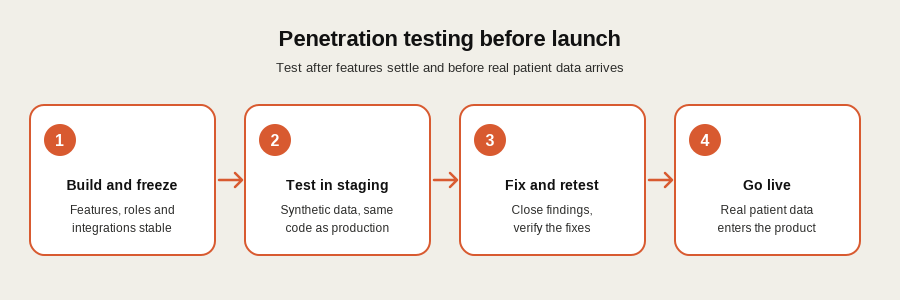
Penetration testing before launch: four steps from feature freeze to going live
If your beta uses real patient data, treat the beta date as your launch date and test before it. If your beta uses only synthetic data, you can test later, as long as the test finishes before real data arrives.
Planning a launch or pilot and not sure when to book testing? Book a scoping call and we will work backwards from your date to find the window.
What to Test Before You Launch
For most HealthTech products, the highest value areas are the ones that protect patient data:
- Authentication and sessions. Login, password reset, multi factor flows, and session handling.
- Authorization. Whether one user, clinic, or organization can see another’s records.
- APIs. The endpoints behind your web and mobile interfaces, including ones that are not visible in the UI.
- File handling. Uploads, exports, and anything that moves documents containing patient information.
- Integrations. Connections to EHRs, labs, billing, or messaging services.
If you are choosing who runs the test, our pentest vendor evaluation guide lists the questions that separate vendors on depth, reporting, and retesting.
Using Staging and Synthetic Data
You do not need real patient data to test well. A staging environment with realistic synthetic records lets testers exercise the same features without exposing anyone. Check a few things first:
- Parity with production. Staging should use the same code, configuration, and integrations, otherwise findings may not apply.
- Realistic data. Enough records and roles to test boundaries between users and organizations.
- No real data by accident. Confirm that no production records were copied into staging.
- Stable access. Test accounts for each role, available for the whole engagement.
Common Mistakes When Testing Before Launch
- Testing too early. Features change after the test and the report no longer reflects the product.
- Testing the week of launch. Findings arrive with no time to fix or retest them.
- Narrow scope. Testing only the main app and leaving out the API or integrations that handle patient data.
- Skipping the retest. A report with open findings is a weaker piece of evidence than one showing the fixes were verified.
- Waiting for real data. Using launch as the trigger instead of the date real data arrives.
How We Help HealthTech Startups Before Launch
We work with HealthTech startups preparing for a first launch, pilot, or beta. We scope the test around where patient data will actually flow, run it in staging with synthetic data, and deliver a report that a partner or reviewer can read without a walkthrough. Retesting is quoted after we review the findings, so the scope matches what actually needs verifying. You can read more about our approach on the HIPAA penetration testing page.
FAQ
Is a penetration test required before launching a HealthTech product? Not as a blanket rule, to our knowledge. Requirements depend on your customers, partners, and contracts, and many ask for one. Confirm what your pilot partner or customer expects.
Can we test before launch without real patient data? Yes. A staging environment with synthetic data is the usual approach and avoids exposing real records to testers.
How early should we book? Plan for scoping, scheduling, testing, fixes, and a retest, working backwards from the date real patient data arrives. Booking several weeks ahead is a reasonable starting point, though availability varies.
What if we change features after the test? Significant changes may need additional testing. Ask your vendor how they handle scope changes and whether a focused retest of new functionality is possible.
Should we wait until after launch to save budget? It can feel cheaper, but a problem found after launch happens with real data at stake. Scoping the test to the areas that handle patient data is a common way to keep cost manageable.
If a launch, beta, or pilot is coming up and you want testing finished before real patient data arrives, book a scoping call.
Packet33 is a penetration testing and compliance advisory firm serving SaaS and HealthTech startups in the US, Canada, and UK.

Mohamed is the founder of Packet33. He worked as a cybersecurity analyst before launching the firm and now leads an OSCP-certified team serving SaaS and HealthTech startups in the US, Canada, and UK.