
Key Takeaways
- SOC 2 does not explicitly name penetration testing as mandatory, but auditors expect one in practice for any company handling sensitive data at scale.
- HIPAA does not name penetration testing as a required control either, it requires a risk analysis, and a pentest is the most common way companies demonstrate one was performed thoroughly.
- Neither framework technically requires a pentest by name, both create strong practical pressure to have one, for different reasons.
- A single, well scoped pentest can usually satisfy both frameworks at once if the scope explicitly covers systems and data in both categories.
SOC 2 vs HIPAA pentest requirements is a confusing comparison because both frameworks share the same quirk, neither one technically mandates a penetration test by name, and both create enough practical pressure that skipping one is a real risk either way. For a HealthTech startup handling both PHI and standard SaaS customer data, understanding where these two frameworks actually overlap and where they diverge determines whether you need one pentest or two.
What SOC 2 Actually Requires
SOC 2’s Trust Services Criteria do not contain the word “penetration test.” What they require is evidence that a company monitors for vulnerabilities and evaluates the effectiveness of its security controls on an ongoing basis, criteria CC4.1 and CC7.1 in particular. In practice, auditors have converged on penetration testing as the standard way to satisfy this evidence requirement, to the point where a Type 2 audit without one is unusual enough to draw direct questions. Type 1 reports, which assess design at a single point in time, face less pressure for a pentest specifically, Type 2 reports, which assess operating effectiveness over a period, almost always expect one.
What HIPAA Actually Requires
HIPAA’s Security Rule works the same way from a different angle. It requires a documented risk analysis and ongoing risk management, not a penetration test specifically. But a risk analysis that only covers policy review, without any technical verification of whether the described safeguards are actually configured correctly, is a weak one, and increasingly auditors and enterprise partners expect technical testing as part of a credible risk analysis. A 2025 proposed HIPAA update from HHS moves further in this direction, explicitly proposing more frequent technical testing requirements rather than leaving it implied.
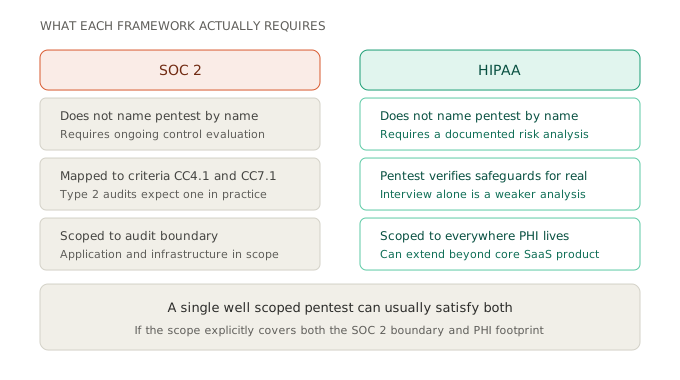
Where the Two Frameworks Overlap and Where They Differ
The overlap is real. Both frameworks care about the same underlying question, can an attacker actually get to sensitive data, and both are satisfied by the same kind of evidence, a manual penetration test with a clear methodology, documented findings, and remediation tracking. If your application handles both PHI and general SaaS customer data on the same infrastructure, a single well scoped pentest covering that shared environment typically satisfies both frameworks’ expectations at once.
Where they diverge is scope and framing. SOC 2 pentests tend to focus on the application and infrastructure supporting the service commitments in your audit report. HIPAA risk analyses need to specifically account for everywhere PHI lives, moves, and is stored, which sometimes extends into systems a SOC 2 scope would not naturally include, a backup system, an analytics pipeline, or a third party integration that touches patient data but is not part of your core SaaS product.
Not sure whether your environment needs one pentest or two separate scopes? Book a scoping call and we will map your actual PHI footprint against your SOC 2 boundary before you commit to either.
Does HIPAA Require a Pentest, Specifically?
No, not by explicit name, the same as SOC 2. What HIPAA requires is a risk analysis, and a penetration test is the strongest, most defensible way to demonstrate that analysis actually verified your technical safeguards rather than just documenting what you intended them to be. Skipping technical testing does not violate HIPAA directly, it just leaves your risk analysis resting entirely on interview answers, which is a weaker position if a breach ever triggers an OCR investigation and your safeguards turn out not to match what was documented.
What This Means for Scoping
If you are a HealthTech startup navigating SOC 2 compliance and HIPAA requirements at the same time, the practical move is scoping one engagement that explicitly covers both, rather than treating them as two separate purchases. A HealthTech compliance pentest scoped this way usually costs less than two standalone engagements and avoids the gap where a narrowly SOC 2 scoped pentest misses a PHI touching system that only shows up in a proper HIPAA risk assessment. This is exactly the kind of dual framework scope we build into our HIPAA penetration testing engagements when a client’s environment spans both frameworks.
Frequently Asked Questions
Can one pentest satisfy both SOC 2 and HIPAA? Usually yes, if the scope is defined broadly enough to cover both your SOC 2 audit boundary and everywhere PHI lives, moves, and is stored. The scoping conversation is where SOC 2 vs HIPAA pentest requirements actually get reconciled, not after the fact.
Does a HIPAA risk assessment replace the need for a SOC 2 pentest, or vice versa? No. They ask overlapping but not identical questions. A risk assessment interview alone does not verify technical controls the way a pentest does, and a SOC 2 scoped pentest may not cover every system that touches PHI.
Which framework creates more urgency to test, SOC 2 or HIPAA? Both create real pressure in practice, even though neither mandates testing by name. SOC 2 Type 2 auditors expect it as standard evidence, and HIPAA risk analyses are considered weaker without it, particularly as HHS moves toward more explicit technical testing expectations.
Understanding SOC 2 vs HIPAA pentest requirements upfront is what keeps a dual framework engagement from turning into two separate, overlapping purchases.
If you are scoping a pentest that needs to satisfy both SOC 2 and HIPAA at once, book a scoping call and we will build a single scope that covers both rather than pricing them separately.
Packet33 is a penetration testing and compliance advisory firm serving SaaS and HealthTech startups in the US, Canada, and UK.

Mohamed is the founder of Packet33. He worked as a cybersecurity analyst before launching the firm and now leads an OSCP-certified team serving SaaS and HealthTech startups in the US, Canada, and UK.