
The demo went well. The prospect loved the product. Pricing conversations were happening. Then someone from their IT or procurement team got involved and everything slowed down.
An enterprise security review landed in your inbox, a questionnaire, a request for documentation, or simply an email asking whether you have completed an independent penetration test. If you were not expecting it, you are now in a position that every SaaS founder eventually finds themselves in: scrambling to produce evidence of a security program that may or may not exist in a form the buyer will find credible.
The good news is that an enterprise security review is entirely survivable, even for an early-stage startup. The founders who get through them quickly are not the ones with the most sophisticated security programs. They are the ones who had the right documentation ready before the review started.
Here is exactly what that looks like.
What an Enterprise Security Review Actually Is
An enterprise security review is the process a buyer uses to evaluate whether a vendor’s security posture is acceptable before sharing data or granting system access. It is standard practice at any company with a dedicated security team or a compliance requirement of their own, and it happens regardless of how good your product is or how far along the commercial conversation has progressed.
The review typically takes one of three forms. Sometimes it is a written questionnaire, anywhere from 30 to 300 questions covering your security controls, data handling practices, and compliance certifications. Sometimes it is a document request, the buyer’s security team asks for specific evidence like your penetration test report, your SOC 2 report, or your incident response policy. Sometimes it is a combination of both, followed by a call with their security team to discuss the findings.
What all three have in common is that they are evaluating the same underlying question: if something goes wrong with this vendor, are they equipped to contain it, and did we do our due diligence before bringing them in?
Why Enterprise Security Reviews Stall Deals
The deals that stall are almost never killed by the security review. They are paused by it. A buyer’s security team flags a gap, requests additional evidence, escalates for a risk exception, or asks you to complete testing you have not done yet. Each of those steps adds weeks to a sales cycle that was already close to closing.
The most common gaps that cause delays are predictable and preventable.
No penetration test report is the single most common sticking point. Enterprise security teams expect to see an independent test of your application, not a vulnerability scan, not an internal assessment, but a report from a credentialed external firm covering your web application and API surface. Your pentest report is often the first technical proof that your company takes security seriously. Enterprise buyers are not simply asking whether you completed a penetration test, they are evaluating whether your organisation understands real-world security risk well enough to protect their data. Without a current report, the security team has to escalate for a risk exception or ask you to get one done before the deal can proceed.
An outdated report is almost as problematic. A test completed 18 months ago that predates significant infrastructure changes provides limited assurance. Enterprise security teams review the date on your report and compare it to what they know about how quickly SaaS products evolve. A report older than 12 months will raise questions regardless of how clean the findings were.
Missing or generic security policies are another common gap. Most buyers will ask for your information security policy, your incident response plan, and sometimes your vendor management policy. Auto-generated templates that have not been customized to reflect how your company actually operates are easy to spot. A policy that says you conduct quarterly access reviews when your team has never done one is a liability, not an asset.
No compliance certification or no clear path to one is increasingly a blocker for enterprise healthcare and financial services buyers specifically. SOC 2 Type II has become a baseline expectation in many enterprise procurement processes. Not having it does not automatically kill the deal, but not having a credible timeline for achieving it often does.
What to Have Ready Before the Review Starts
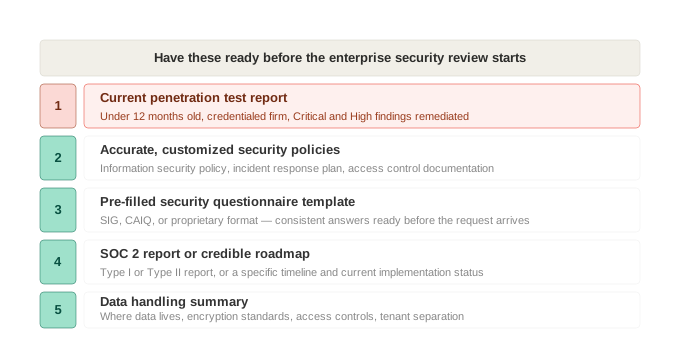
The founders who move through enterprise security reviews fastest have these five things in place before the conversation starts. None of them require a full security team or an enterprise budget.
A current penetration test report. This is the highest-leverage document in any enterprise security review. A web application and API pentest from a credentialed firm, with OSCP or equivalent certified testers covers the most common question a security team will ask. The report should be less than 12 months old, should document the scope clearly, and should include remediation evidence for any Critical or High findings. According to OWASP, the vulnerabilities that matter most to enterprise buyers, broken access control, injection flaws, authentication failures, are the ones that require manual testing to find reliably. A credible report signals that your security posture has been validated by someone other than your own engineering team.
Accurate, customized security policies. Your information security policy, incident response plan, and access control documentation should reflect how your company actually operates, not how a template assumes you operate. A buyer’s security team will ask follow-up questions about your policies. If your team cannot answer those questions in a way that matches what the policy says, it creates doubt that is very hard to recover from.
A completed security questionnaire template. Most enterprise buyers use one of a handful of standard formats; SIG, CAIQ, or a proprietary version. Maintaining a pre-filled version of your standard questionnaire answers means you can respond in days rather than weeks when one arrives. It also forces your team to have clear, consistent answers to the most common questions before you are under pressure to produce them.
SOC 2 status or a credible roadmap. If you have a SOC 2 Type I or Type II report, share it. If you are in the process of pursuing one, be ready to say specifically where you are in the timeline and when you expect the report to be available. A founder who says “we are implementing controls now and targeting our Type II audit in Q3” is in a much better position than one who says “we are planning to look into it.”
A clear data handling summary. Where does customer data live, how is it encrypted, who has access to it, and how is it separated from other customers’ data? These questions come up in almost every enterprise security review and your answers should be documented, consistent, and available on short notice.
Talk to us about getting your security documentation ready before your next enterprise deal.
The Role of the Penetration Test in Closing the Deal
Of everything above, the penetration test is the most commercially important document. It is also the one that takes the most time to produce, which is why the right time to get it done is before you need it, not after a deal is already stalled waiting for it.
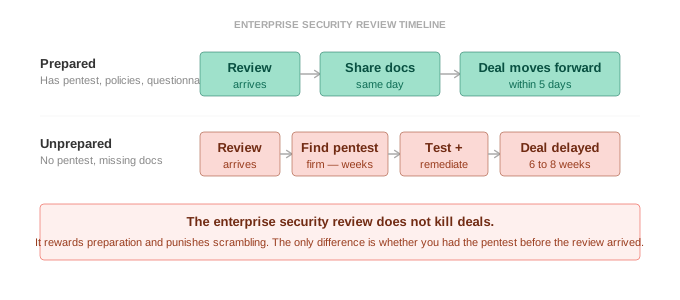
A founder who can respond to an enterprise security review with a current pentest report, clean remediation evidence, and a pre-filled questionnaire shortcircuits weeks of back-and-forth with the buyer’s security team. The security team has what they need to make a recommendation. The deal moves forward.
A founder who receives the review and then starts the process of finding a pentest firm, scoping the engagement, completing the test, remediating findings, and retesting, all while a deal is waiting, is looking at a minimum of six to eight weeks of delay. In competitive sales situations, that delay is often decisive.
The Honest Bottom Line
The enterprise security review is not a barrier. It is a predictable step in every enterprise sales process that rewards preparation and punishes scrambling. Getting a pentest done proactively, maintaining accurate security policies, and having your documentation organized before a deal reaches this stage is the difference between a review that takes five days and one that takes five months.
Packet33 conducts web application, API, and external network penetration tests for SaaS and HealthTech startups, with reports scoped and formatted for enterprise security reviews, SOC 2, and HIPAA requirements. We work on the timelines our clients are actually operating under.
View the Startup Security Questionnaire Response Guide
If you want a quote tied to your actual environment instead of a flat rate guess, book a scoping call and we will walk through what drives your specific number, start with our SaaS penetration testing post if you want the full breakdown of what is included first.
Packet33 is a penetration testing and compliance advisory firm serving SaaS and HealthTech startups in the US, Canada, and UK.

Mohamed is the founder of Packet33. He worked as a cybersecurity analyst before launching the firm and now leads an OSCP-certified team serving SaaS and HealthTech startups in the US, Canada, and UK.