
You did the right things. You signed up for Vanta, connected your AWS environment, synced your HR tool, and watched the dashboard turn green. You spent weeks chasing down control owners, got your policies published, and pushed your readiness score above 90%. You booked an auditor. You felt ready.
Then audit week arrived.
The auditor asked why your incident response policy referenced a runbook that did not exist. They flagged that your access review had been completed on paper but not evidenced inside the platform. They noticed your penetration test report was from 18 months ago and the scope did not cover your current production environment. Three days into a five-day audit, you were scrambling.
This is not a made-up scenario. It happens constantly. And it happens to teams that genuinely put in the work.
Here is the part nobody explains clearly when you sign up for a GRC platform: SOC 2 audit prep is not the same as having a high readiness score. The platform is the tool that supports the compliance program. Those are two very different things.
What GRC Platforms Actually Do
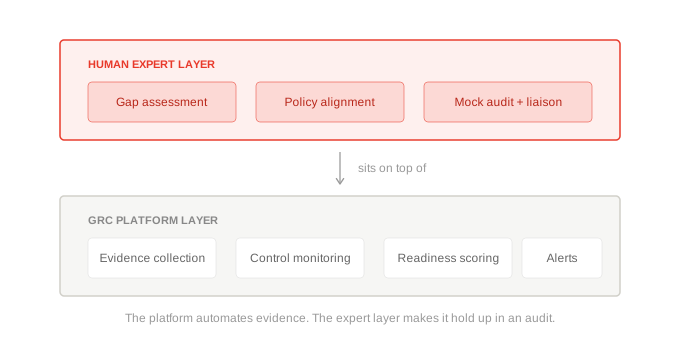
Tools like Vanta, Drata, Secureframe, and Sprinto are genuinely excellent at what they were built for. They connect to your cloud infrastructure, identity provider, HR system, and developer tools. They automatically pull evidence that controls are in place. They monitor those SOC 2 controls on an ongoing basis and alert you when something drifts out of compliance. They generate a dashboard that tells you, in real time, where your readiness score stands.
This automation saves hundreds of hours of manual work. Before these platforms existed, startups were collecting compliance evidence in spreadsheets and shared drives. Nobody misses that.
But here is what the platform cannot do. It cannot tell you whether your policies reflect how your engineering team actually operates, or whether they are just templated language you accepted at setup. It cannot determine which of the 40 failing controls in your dashboard are genuinely critical for your auditor versus which ones are low-risk noise. It cannot coach your CTO through the questions an auditor will ask about your change management process. It cannot look at your penetration test scope and tell you that your new microservices architecture changed your attack surface in a way the test did not cover.
Those are judgment calls. They require someone who has been through audits, understands what auditors actually look for, and knows how to translate a green dashboard into a defensible security program.
The Gap Between “Audit Ready” and Ready for an Audit
There is a meaningful difference between a platform telling you that you are audit ready and being genuinely prepared for an external auditor to scrutinize your controls.
GRC platforms score you against a set of automated tests. Those tests are designed to check whether controls exist and are configured correctly within the systems the platform integrates with. They are not designed to replicate the judgment of an experienced auditor who has reviewed hundreds of SOC 2 reports and knows exactly which evidence gaps, policy weaknesses, and control inconsistencies tend to result in qualified opinions or findings.
A few things that routinely trip up startups on audit day even after a clean readiness score.
Policy authenticity. SOC 2 auditors are not reviewing whether you have a policy document on file. They are reviewing whether that policy accurately describes how your organization actually operates. Auto-generated templates that have not been customized to reflect your real engineering workflows, your actual incident response process, and your specific vendor relationships will get challenged. Auditors ask follow-up questions. If your team cannot answer those questions in a way that matches what the policy says, that is a problem.
Evidence quality vs. evidence presence. Your platform might show that a control is passing because a screenshot was uploaded. But was the screenshot from the right time period? Does it show what the auditor actually needs to see? Does it match the description in your policy? Evidence that exists but does not tell a coherent story can cause just as many issues as missing evidence.
Penetration testing scope. Many SOC 2 auditors, while not required to, will ask about penetration testing as part of their risk assessment inquiry. If you have a pentest report, they will look at whether the scope reflects your current environment. A test that was scoped against infrastructure you have since changed, or one that excluded your web application because it was out of scope at the time, raises questions about whether you have real visibility into your attack surface. View our Penetration Testing service.
Auditor communication. On audit day, someone needs to be the interface between your team and the auditor. That person needs to know which questions to answer directly, which ones to push back on, and how to manage requests for additional evidence without creating more problems than they solve. Most startup founders and engineers have never done this before.
What Good SOC 2 Audit Prep Actually Looks Like
Getting genuinely audit-ready is not about having the highest dashboard score. It is about working backward from what your auditor will actually examine and making sure there are no surprises.
That starts with a gap assessment that looks at your program through an auditor’s eyes, not through the lens of an automated scoring system. It means reviewing your policies not for whether they exist, but for whether they are accurate, specific, and defensible. It means running a mock audit before the real one, so that any weaknesses in your evidence package or control narrative get surfaced and fixed before they show up as findings.
It also means having someone in your corner during the actual audit who has done this before and can keep the process moving without your engineering team losing a week of productivity.
The Platform Is the Engine. Someone Still Has to Drive It.
GRC platforms changed the compliance landscape for startups in a real and meaningful way. The automation they provide is genuinely valuable, and getting SOC 2 without one today would be far more painful than it needs to be.
But the founders who walk into audit week confidently are not the ones who had the highest readiness score. They are the ones who had an expert review their program before the auditor did, found the gaps that the dashboard missed, and went into the audit knowing exactly what was coming.
If you are using Vanta, Drata, Secureframe, or another GRC platform and you have an audit coming up in the next three to six months, the most important thing you can do right now is get a second set of eyes on your program before your auditor does.
That is exactly what Packet33’s Audit Readiness service is built for. We work inside your existing GRC platform, review what your auditor will actually see, and make sure what is there holds up. No platform replacement required.

Mohamed is the founder of Packet33. He worked as a cybersecurity analyst before launching the firm and now leads an OSCP-certified team serving SaaS and HealthTech startups in the US, Canada, and UK.