
Most SaaS founders encounter the SOC 2 question before they are anywhere near ready for a formal audit. A prospect asks, the deal stalls, and suddenly you are trying to figure out how to prove SOC 2 before audit has even started. The good news is that a formal SOC 2 audit is not the only way to satisfy an enterprise buyer, and for most early-stage companies, starting with a readiness phase before the audit saves thousands of dollars and closes deals faster.
What Enterprise Buyers Want to See Before Your SOC 2 Audit
SOC 2 isn’t a certification, it’s a framework for showing that your organization protects customer data in a structured, verifiable way.
It’s become the “trust language” for SaaS providers, MSPs, and professional service firms.
Even companies outside regulated industries now use SOC 2 reports to win contracts and pass vendor risk reviews.
The challenge: most smaller organizations may not know where to start.
What You Can Show Before the Audit Is Complete
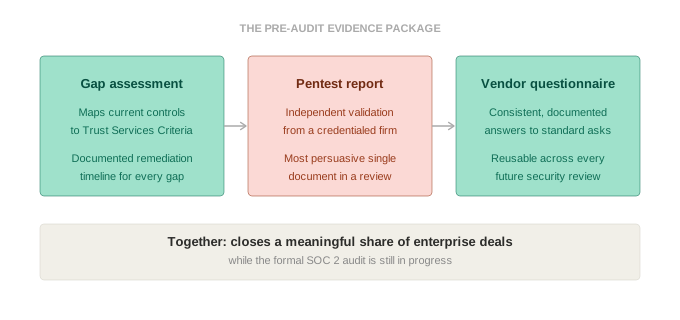
A prospect who asks for SOC 2 is really asking whether your security program is real and operating. A formal audit report answers that definitively, but it takes months and costs money. In the meantime, there are three things that satisfy most enterprise buyers at the seed and Series A stage without a completed audit.
A gap assessment with a remediation timeline shows the prospect you know exactly where you stand against the SOC 2 Trust Services Criteria and have a documented plan to close the gaps. Sharing this proactively signals maturity and builds more trust than vague reassurances about security.
A penetration test report from a credentialed firm is often the single most persuasive document in an early-stage vendor security review. It demonstrates that your security posture has been independently validated. Most enterprise security teams recognize a quality pentest report immediately and treat it as meaningful evidence even in the absence of a full SOC 2 report.
A completed vendor security questionnaire with documented, consistent answers to your controls tells the prospect your program is real enough that you can describe it precisely. Many founders make the mistake of treating questionnaires as one-off exercises, building a standard response set that maps to your actual controls turns them into a repeatable sales asset.
Together these three things form a pre-audit evidence package that closes a meaningful portion of enterprise deals while the formal audit is in progress.
The Problem With Jumping Straight Into an Audit
Auditors expect clear, documented controls, completed access reviews, a tested incident response plan, and formal vendor management policies already in place before fieldwork begins. If you have not implemented those yet, the audit itself becomes an expensive way to find out what is missing, auditors find gaps during fieldwork, they do not fix them for you.
This is the part that catches most first-time SOC 2 founders off guard financially. A Type 1 audit fee alone typically runs $5,000 to $20,000, and for a 10 to 50 person startup the all-in Type 1 cost, including readiness work, tooling, and internal time, usually lands between $28,000 and $58,000. Type 2 costs more across every line item, with all-in first-year spend commonly reaching $50,000 to $120,000 once you include the longer observation period and more extensive evidence requirements.
Those numbers assume you walk into fieldwork already prepared. If the auditor uncovers significant gaps mid-engagement, remediation under that kind of time pressure typically costs two to three times what the same fixes would have cost during a proper readiness phase, and your timeline stretches by months while you scramble to close findings the auditor has already flagged.
There is also a time cost that does not show up on any invoice. Founders going through their first SOC 2 Type 1 typically spend 240 to 380 internal hours across the founder, CTO, and ops team, roughly five to ten hours a week for the founder or security lead during an active engagement, plus one to two hours per employee for security training. Skipping a readiness phase does not eliminate this time cost. It just moves it to the worst possible moment, in the middle of an audit your auditor is actively scoring.
A proper readiness phase exists specifically to absorb this risk before the clock is running on a formal engagement.
What a Real Readiness Phase Actually Looks Like
A readiness assessment is not a formality before the real work starts. It is the work that determines whether your formal audit takes weeks or months, and whether your first SOC 2 report comes back clean or full of exceptions.
The first thing a proper readiness phase does is scope. Most early-stage SaaS startups only need to pursue the Security criterion in their first year, adding Availability, Confidentiality, or Processing Integrity multiplies both cost and timeline, and most enterprise buyers do not require them yet. A tight first-year scope typically covers your production environment only, excluding development and staging, and limits the boundary to systems and personnel that actually touch customer data.
The second thing it does is identify which controls you already have versus which ones exist only on paper. This is where most startups discover the gap between what their GRC platform dashboard shows as green and what an auditor will actually accept as evidence. A control marked “implemented” because a policy document exists is different from a control an auditor will sign off on, which requires documented evidence that the policy is actually being followed.
The third thing is building the evidence library before you ever talk to an auditor, access review records, incident response test documentation, vendor security assessments, and policy acknowledgments, organized in a way that maps directly to the Trust Services Criteria your auditor will be checking against.
At Packet33, our approach to this phase is built specifically for lean teams: we focus only on the controls relevant to your actual business model and architecture rather than a generic checklist, we work inside your existing GRC platform to automate evidence tracking rather than asking you to adopt new tooling, and we map your readiness work to SOC 2 first while keeping ISO 27001 or NIST CSF alignment in view if either becomes relevant to your buyer base later.
A readiness assessment specifically, separate from the audit itself, typically costs $5,000 to $20,000 depending on your current security maturity and scope complexity. Done properly upfront, that spend is what keeps your total first-year cost in the $20,000 to $58,000 range rather than sliding toward the higher end once unplanned remediation gets added mid-audit.
Book a scoping call to see what your audit readiness engagement would look like.
Packet33 is a penetration testing and compliance advisory firm serving SaaS and HealthTech startups in the US, Canada, and UK.

Mohamed is the founder of Packet33. He worked as a cybersecurity analyst before launching the firm and now leads an OSCP-certified team serving SaaS and HealthTech startups in the US, Canada, and UK.