
A pentest cost comparison between vendors is one of the most confusing exercises in buying security services. You send the same scope to three firms and get back quotes of $6,000, $14,000, and $26,000. Same application. Same stated methodology. Wildly different numbers. This happens constantly and it is not random. Here is what is actually behind the variance.
How Much a SaaS Pentest Actually Costs
Before getting into what drives price differences, it helps to know the realistic ranges so you can orient yourself when quotes arrive.
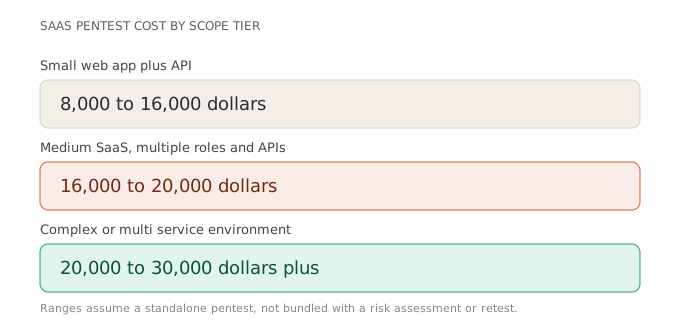
For a seed or pre-revenue SaaS startup with a single web application, a focused pentest covering authentication, authorization, and core data flows typically runs between $8,000 and $16,000. This assumes a limited scope; one user role, a handful of API endpoints, no complex integrations.
For a Series A SaaS company with a more mature product, multiple user roles, and an API surface, expect $16,000 to $20,000 for a credible manual engagement. The scope is wider and the testing time required increases non-linearly with complexity.
For a Series B Startup and beyond, with microservices, multiple environments, third-party integrations, and compliance requirements driving the scope, $20,000 to $30,000 plus for a thorough web application and API pentest is a realistic budget. Beyond that range you are typically looking at red team engagements or full-stack assessments that go well beyond what most growth-stage SaaS companies need.
The number that surprises most founders is the all-in cost. The invoice from your pentest firm is not the total spend. Add remediation engineering time, typically two to four weeks of a senior engineer’s time for a meaningful set of findings, plus a retest to verify fixes were effective, and the total annual cost of a well-run pentest program is often two to three times the original invoice. Plan for that number, not the quote.
What Actually Drives the Price Up or Down
Testing hours and methodology. This is the biggest driver and the hardest to see from a quote alone. A $6,000 quote might represent 15 hours of actual testing time, mostly automated scanning with a human reviewing the output. A $20,000 quote for the same application might represent 60 hours of manual testing by a senior tester who is actively attempting to chain vulnerabilities, bypass business logic, and exploit the application the way a real attacker would.
The OWASP Testing Guide covers the categories of vulnerabilities a thorough manual test should address. Automated tools catch a subset of these, primarily known vulnerability patterns and misconfigurations. Business logic vulnerabilities, authorization failures between user roles, and IDOR issues in APIs almost always require manual testing to find. If a vendor cannot tell you how many hours of manual testing are included, that is the question to ask before comparing prices.
Tester experience and credentials. OSCP, OSWE, CREST, and GIAC certifications track with day rates. A firm staffed with senior certified testers costs more than one using junior analysts running automated tooling. This matters because the quality of findings, their accuracy, their exploitability, the proof-of-concept evidence, is directly tied to tester skill. A finding that says “SQL injection may be possible in the login endpoint” without exploitation evidence is not a validated finding. A finding with a working proof of concept and a clear exploit chain is.
Scope complexity. Every additional user role, API endpoint, microservice, subdomain, and third-party integration adds testing time. A web application with one user role and twenty API endpoints is fundamentally different from the same application with four user roles, sixty endpoints, and two external integrations. Vendors who scope carefully before quoting will ask detailed questions about your architecture. Vendors who quote quickly based on “one web app” are not accounting for complexity, and their quote will either be padded with margin or will result in a shallow test.
Testing type. Black-box testing, where the tester starts with no credentials or knowledge of the application, is faster to set up but shallower, it simulates an external attacker with no prior access. Grey-box testing, where the tester has credentials and basic documentation, is the most common and most useful approach for SaaS companies, it covers both external and authenticated attack paths. White-box testing, which might include source code review alongside active testing, is the most thorough and typically 30 to 50 percent more expensive than grey-box for the same scope. Most SaaS startups need grey-box for their first several engagements.
Report quality and remediation guidance. A pentest report is not just a list of findings. The quality of the remediation guidance, the clarity of the executive summary, and whether the report maps findings to compliance frameworks like SOC 2 Trust Services Criteria or HIPAA Security Rule safeguards varies enormously between vendors. A report that your engineering team can actually act on, with specific code-level recommendations, proof-of-concept screenshots, and prioritized remediation steps, is worth more than a technically accurate but operationally useless one. Ask to see a sample report before you sign.
Retest inclusion. Some vendors include a retest in the base price and others bill it separately. Always confirm whether retest is included and what it covers, a retest that only checks the original findings is different from one that also looks for new issues introduced during remediation.

What a Pentest Cost Comparison Actually Tells You
The lowest quote in a pentest comparison is almost never the right choice for a SaaS startup with an enterprise deal or compliance audit on the line.
The risk is not that cheap pentests find nothing. It is that they find the easy things, the automated scanner hits, the low-hanging CVSS-scored vulnerabilities, and miss the things that actually matter for your specific application. A business logic flaw that lets one tenant access another’s data will not appear in an automated scan. An authorization bypass in your API that an attacker can chain with a second vulnerability to escalate privileges requires a human tester who understands your application well enough to think about it that way.
When a prospect’s security team or your SOC 2 auditor asks about your pentest, they are not just checking whether you have a report. They are evaluating whether the report represents a credible assessment of your actual security posture. A report that is obviously automated, lacks manual evidence, or comes from an unknown firm with no verifiable credentials will raise more questions than it answers.
What to Ask Before You Sign
The question that most quickly separates credible pentest vendors from the rest is this: how many hours or days of manual testing are allocated to this engagement, and who specifically will be doing the testing?
A firm that cannot answer that question clearly is telling you something important. A firm that gives you a specific number of testing hours, names the testers and their credentials, and offers to show you a sample report before you sign is giving you the information you need to evaluate what you are actually buying.
Beyond that, confirm whether retest is included, how findings are prioritized, whether the report maps to any compliance frameworks relevant to your situation, and what the timeline looks like from contract signing to report delivery. Our current approach to retests is to price it separately based on the number of findings.
Pentest pricing for SaaS startups is confusing precisely because the variance in what you are buying is so large. Two quotes for the same application can legitimately differ by $20,000 and both be accurate, they just represent fundamentally different levels of rigor.
Packet33 conducts web application, API, and external network penetration tests for SaaS and HealthTech startups. We provide fixed-scope quotes with transparent testing hours, OSCP-certified testers, and reports formatted for SOC 2, ISO 27001, HIPAA, and enterprise security reviews.
If you want a quote tied to your actual environment instead of a flat rate guess, book a scoping call and we will walk through what drives your specific number, start with our SaaS penetration testing post if you want the full breakdown of what is included first.
Packet33 is a penetration testing and compliance advisory firm serving SaaS and HealthTech startups in the US, Canada, and UK.

Mohamed is the founder of Packet33. He worked as a cybersecurity analyst before launching the firm and now leads an OSCP-certified team serving SaaS and HealthTech startups in the US, Canada, and UK.