
Key Takeaways
- A health plan security review usually arrives after the business team says yes and before the pilot can start, so it decides your launch date more often than the contract does.
- Requirements vary by plan, but most reviews ask for the same core evidence: a questionnaire, a recent independent penetration test, a HIPAA risk analysis, and your policies.
- Reviewers care most about how you handle member data, especially anything like SSNs, so know exactly where it is stored, who can reach it, and how it is protected.
- Preparing the evidence before the request arrives is the difference between a review that takes days and one that stalls the pilot for weeks.
The first health plan security review tends to catch HealthTech startups off guard. The pilot is agreed, the champion inside the plan is excited, and then a security team you have never spoken to sends a spreadsheet with a few hundred questions and a deadline. Here is what these reviews typically look for, what to have ready, and how a penetration test fits in.
What a Health Plan Security Review Usually Involves
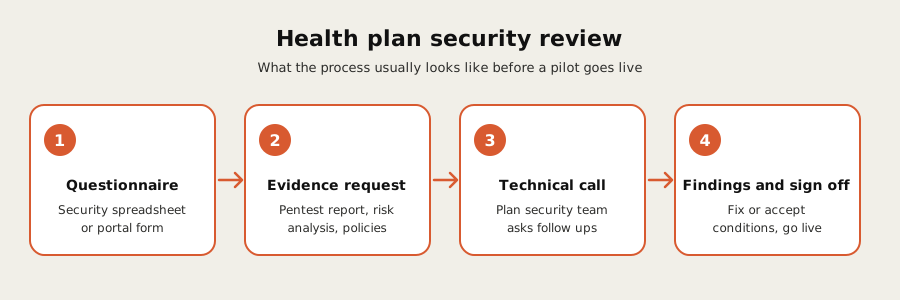
Every plan runs its own process, but the stages are similar:
- A security questionnaire. Often a long spreadsheet or portal form covering access control, encryption, logging, incident response, and vendor management.
- An evidence request. Documents that back up your answers: policies, a recent penetration test report, a risk analysis, and sometimes a SOC 2 report.
- A technical call. A short conversation with the plan’s security team to clarify answers and probe anything unclear.
- Findings and sign off. Open issues are reviewed, and you may be asked to fix items or accept conditions before the pilot goes live.
Because the plan will be handing you member data, it is accountable for how you protect it. Under HIPAA, a vendor that handles protected health information on a plan’s behalf is a business associate, and the plan is expected to take reasonable steps to confirm that safeguards are in place. The HHS summary of the HIPAA Security Rule explains the safeguards that apply.
What Reviewers Typically Ask For
The exact list differs, but these items come up again and again:
- A recent independent penetration test. Often within the last 12 months, covering the application and APIs that touch member data.
- A HIPAA risk analysis. Evidence that you have identified risks to electronic protected health information and are managing them.
- Policies and procedures. Access control, incident response, vendor management, and data retention.
- Data handling details. Where member data lives, how it is encrypted in transit and at rest, and who can reach it.
- Third party and subprocessor list. The cloud provider and any other service that touches the data.
- A business associate agreement. Usually signed before any member data moves.
None of this is unusual, and none of it needs to be perfect. It needs to be organized, current, and honest.
Preparing for your first health plan review? Book a scoping call and we will walk through what a reviewer is likely to ask for and where your evidence has gaps.
Why Member Data and SSNs Raise the Bar
If your product handles Social Security numbers, dates of birth, or claims data, expect closer questions. Reviewers tend to look for three things:
- Minimization. Do you actually need the SSN, or can you work with a member ID?
- Isolation. Is one plan’s data separated from another customer’s, and can one user see another user’s records?
- Protection in practice. Encryption, access logging, and a clear answer to who can view the raw data internally.
Those are exactly the areas a penetration test examines, which is why reviewers ask for one. A report that shows your authorization checks and data separation were tested by an independent party answers many questionnaire items at once.
Where a Penetration Test Fits
A penetration test gives the reviewer something a questionnaire cannot: evidence that someone outside your team tried to break in and reported what happened. For a pilot, the useful version has a few features:
- Scope that matches the pilot. The application, APIs, and environments that will handle member data.
- Testing behind the login. Roles and tenants matter most, so the test should use accounts for each role and at least two separate customers.
- Documented fixes. Findings with remediation notes and a retest, so the report shows issues were closed.
- A report a reviewer can read. Clear scope, method, and results, plus an attestation letter if the plan asks for a short summary.
If you are still choosing who should run the test, our pentest vendor evaluation guide covers the questions that separate vendors, and the HIPAA penetration testing page describes how we scope tests for covered entities and business associates.
A Preparation Checklist Before the Request Arrives
Start four to eight weeks before you expect the questionnaire, since a pentest and its retest take time:
- Map your data. A simple diagram showing where member data enters, is stored, and leaves.
- Book the penetration test. Aim for a report in hand before the plan asks, with fixes retested.
- Update the risk analysis. Make sure it reflects the current product and vendors.
- Gather policies. Current versions, dated and approved.
- Prepare standard answers. A reusable response set for common questionnaire items saves time on every review after this one.
- Name one owner. One person who answers reviewer questions keeps the process moving.
How We Help HealthTech Startups Prepare
We work with HealthTech startups heading into their first pilot or plan review. We scope the penetration test around the systems that will handle member data, test behind the login with realistic roles and tenants, and deliver a report written so a security reviewer can follow it without a call. We also help teams line up the supporting evidence so the review does not stall on a missing document.
FAQ
How long does a health plan security review take? It varies by plan and by how quickly you respond. Having evidence ready beforehand usually shortens it considerably. Ask your contact at the plan for their typical timeline.
Do we need a penetration test before the pilot? Many plans ask for a recent one, and some make it a condition of go live. Requirements differ, so confirm with the plan, and plan for the testing and retest time.
Is a SOC 2 report enough on its own? Sometimes it helps, but many plans still ask for a penetration test and HIPAA specific documents. Treat SOC 2 as supporting evidence rather than a replacement.
What if we have open findings when the review starts? That is common. Fix what you can, document a plan and timeline for the rest, and be transparent. Reviewers generally prefer honest status over a report that claims nothing was found.
Can one penetration test serve several plans? Often yes, if it is recent, covers the relevant scope, and is clearly documented. Some plans may ask for additional detail or a different format.
If a pilot or health plan review is coming up and you want your evidence ready first, book a scoping call, or start with our HIPAA penetration testing page for the full breakdown of what is included.
Packet33 is a penetration testing and compliance advisory firm serving SaaS and HealthTech startups in the US, Canada, and UK.

Mohamed is the founder of Packet33. He worked as a cybersecurity analyst before launching the firm and now leads an OSCP-certified team serving SaaS and HealthTech startups in the US, Canada, and UK.